
PRP for Hair Loss in Riyadh – Platelet-Rich Plasma Treatment
Hair thinning and progressive hair loss can affect both men and women and may develop for many different reasons. PRP for hair loss is a minimally invasive treatment that uses a concentrated portion of your own blood to support the hair follicles and may improve hair density and thickness in appropriately selected patients.
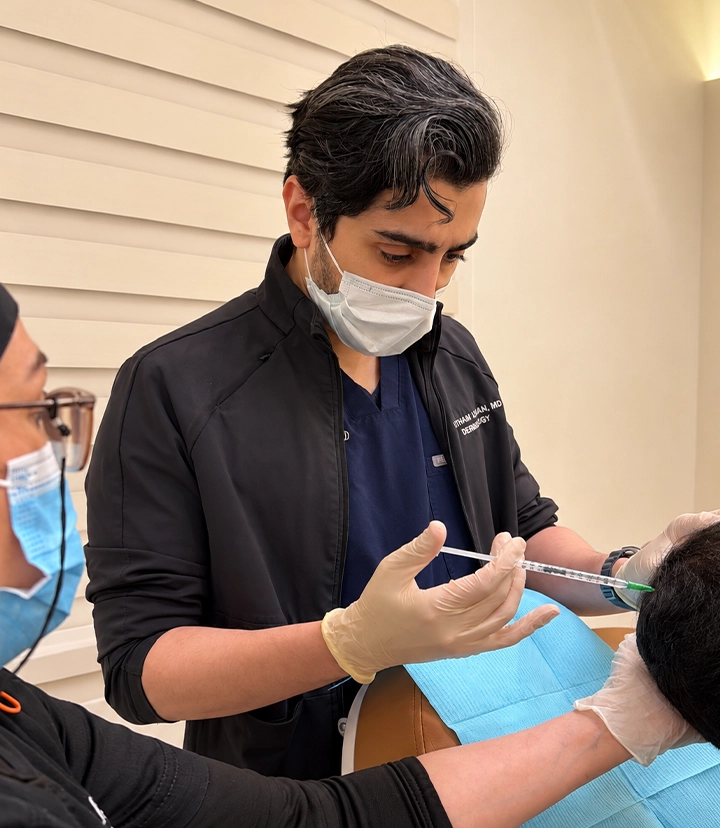
Dr. Haitham Al-Gzlan provides personalized PRP hair-loss treatment in Riyadh, beginning with an assessment of the hair-loss pattern, stage and possible underlying cause before determining whether PRP is suitable.
PRP is not a universal solution for every type of hair loss. Its potential benefit can depend on the diagnosis, remaining follicle activity, treatment protocol and individual response.
What Is PRP for Hair Loss?
PRP stands for platelet-rich plasma. It is prepared from a small sample of your own blood.
During treatment, blood is collected and processed using a centrifuge to separate its components and concentrate the platelets within the plasma. The resulting platelet-rich plasma is then injected into selected areas of the scalp.
Platelets are best known for their role in blood clotting, but they also contain proteins and growth factors involved in tissue repair and cellular signaling. These biological factors are one reason PRP has been investigated as a treatment for hair loss.
How Does PRP Work for Hair Loss?
The exact mechanism of PRP in hair restoration is not completely understood. Research suggests that concentrated platelets may release growth factors and other signaling molecules that influence the environment surrounding the hair follicle.
These biological signals may be involved in processes such as:
- Hair follicle activity
- Cellular proliferation
- Tissue repair
- Blood-vessel formation around follicles
- Hair-growth cycling
- Hair shaft thickness
- Hair density
Facial harmonization does not necessarily mean:
Research has investigated growth factors including vascular endothelial growth factor (VEGF), epidermal growth factor (EGF), platelet-derived growth factor (PDGF) and other signaling molecules.
The purpose of PRP is to concentrate selected components of your own blood and deliver them to areas of the scalp where treatment is being considered.
Who Is a Good Candidate for PRP?
PRP may be considered for selected patients with pattern hair loss or thinning hair, particularly when functioning hair follicles remain in the affected areas.
Potential candidates may include people with:
- Male pattern hair loss
- Female pattern hair loss
- Androgenetic alopecia
- Early or moderate hair thinning
- Reduced hair density
- Progressive thinning with active follicles
However, suitability depends on the reason for the hair loss. A dermatologist may recommend further assessment when shedding is sudden, patchy, associated with scalp inflammation or potentially related to an underlying medical or nutritional condition.
The key consideration is not simply whether PRP is available, but whether it is appropriate for the particular type and stage of hair loss.
PRP for Different Types of Hair Loss
PRP for Androgenetic Alopecia
Androgenetic alopecia, commonly known as male or female pattern hair loss, is one of the main forms of hair loss in which PRP has been studied.
Clinical research has reported improvements in hair measurements following PRP treatment in some patients with pattern hair loss. However, studies have used different treatment protocols and patient populations, so results should not be considered predictable for everyone.
PRP may therefore be considered as one component of a broader treatment plan for appropriately selected patients.
PRP for Thinning Hair
When hair becomes progressively thinner, treatment may aim to support existing follicles and improve the appearance of hair density and thickness.
The potential response can depend on the number and activity of remaining follicles. Earlier assessment may help determine whether the follicles in thinning areas remain suitable for treatment.
PRP for Sudden or Unexplained Hair Loss
PRP is not necessarily the first step when hair shedding begins suddenly or without an obvious explanation.
Hair loss and excessive shedding can be associated with factors such as:
- Stress or significant illness
- Hormonal changes
- Nutritional deficiencies
- Thyroid disorders
- Certain medications
- Inflammatory conditions
- Autoimmune disorders
When the cause is unclear, identifying the underlying condition may be more important than immediately choosing a procedure.
What Happens During PRP Hair Treatment?
A typical PRP treatment involves several stages.
Step 1: Hair-Loss Assessment
Your hair-loss pattern, medical history and previous treatments are reviewed. The scalp and affected areas are assessed to determine whether PRP may be appropriate.
Step 2: Blood Collection
A small amount of blood is collected, usually from the arm.
Step 3: PRP Preparation
The blood sample is processed in a centrifuge. This separates the blood components and allows the platelet-rich portion of the plasma to be prepared.
Step 4: Scalp Injection
The prepared PRP is injected into selected areas of the scalp where treatment is indicated. The injection pattern and treatment technique can vary according to the patient's hair-loss pattern and the clinician's protocol.
Step 5: Follow-Up
Your response is assessed over time. Follow-up can help determine whether further treatment or adjustments to the overall hair-loss plan are appropriate.
How Many PRP Sessions Are Needed for Hair Loss?
There is no single PRP schedule that is appropriate for every patient.
Published studies have used different numbers of treatments, injection techniques and intervals between sessions. Differences in PRP preparation and administration also make it difficult to establish one universal protocol.
The treatment schedule may be influenced by:
- Type and stage of hair loss
- Hair density
- Remaining follicular activity
- Response to previous treatment
- Overall health
- PRP preparation method
- Other hair-loss treatments being used
An initial course may be followed by maintenance or booster treatments when clinically appropriate.
When Can You Expect PRP Hair Results?
PRP does not produce instant hair growth.
Hair develops through a natural growth cycle, so changes in hair density and thickness generally occur gradually. Some patients may notice changes in shedding or hair quality before a visible difference in density becomes apparent.
Results from scalp PRP may become more noticeable over several months, but the response varies between patients and results are not necessarily permanent.
Realistic expectations are therefore an important part of treatment planning.
What Can PRP Potentially Improve?
For appropriately selected patients, PRP may be used with the goal of improving:
- Hair density
- Hair thickness
- Hair shaft diameter
- The appearance of thinning areas
- Hair follicle activity
- Hair growth in selected areas
Clinical studies have reported improvements in hair density and other hair-growth measurements following PRP, although research protocols and patient populations vary.
PRP should therefore be considered a treatment that may improve hair growth and density in selected patients, rather than a guaranteed cure for hair loss.
Why Do PRP Results Vary Between Patients?
PRP does not produce the same response in every patient. Several factors can influence the outcome, including:
- The underlying cause of hair loss
- The stage of hair loss
- The number of functioning follicles
- Individual biological response
- Platelet concentration
- PRP preparation method
- Injection technique
- Treatment frequency
- Other treatments being used
Differences between PRP preparation systems and treatment protocols are also important. This is one reason results from clinical studies cannot always be translated into an identical treatment schedule for every patient.
Is PRP for Hair Loss Safe?
PRP uses components derived from your own blood, which may reduce the likelihood of an allergic reaction compared with some injected medications. However, PRP is still an injection procedure and carries potential risks.
Temporary effects may include:
- Scalp tenderness
- Mild pain or discomfort
- Redness
- Swelling
- Bruising
- Itching
- Headache
Less common injection-related complications can include bleeding, infection, tissue injury or nerve injury.
Your medical history and current medications should be reviewed before treatment to determine whether PRP is appropriate and how the procedure should be performed safely.
What Should You Tell Your Doctor Before PRP?
Before treatment, tell your doctor about:
- Current medications
- Vitamins and supplements
- Blood-thinning medications
- Recent illness or fever
- Bleeding or platelet disorders
- Anemia
- Previous scalp procedures
- Previous hair-loss treatments
- Any sudden or unexplained change in hair shedding
This information can help identify relevant precautions and determine whether additional evaluation is needed before treatment.
PRP vs Other Hair-Loss Treatments
PRP is one option within a broader range of treatments for hair loss. Different approaches have different roles depending on the diagnosis and individual circumstances.
| Treatment | General approach | Potential role |
|---|---|---|
| PRP | Platelet-rich plasma injections | May support hair density and thickness in selected patients |
| Minoxidil | Medication | Used for certain forms of hair loss |
| Finasteride | Medication | Used for selected cases of pattern hair loss |
| Low-Level Light Therapy | Light-based treatment | Non-invasive option for some patients |
| Microneedling | Controlled mechanical stimulation | May be incorporated into selected treatment plans |
| Hair Transplantation | Surgical hair restoration | Moves hair follicles from donor to recipient areas |
The appropriate approach depends on the diagnosis, stage of hair loss, medical history and treatment objectives. PRP may also be considered alongside other therapies when clinically appropriate.
Can PRP Be Combined With Other Hair-Loss Treatments?
Depending on the diagnosis, PRP may be incorporated into a broader hair-loss treatment plan.
A dermatologist may consider medications, device-based treatments, scalp procedures or hair transplantation alongside PRP when appropriate.
The combination should be based on the cause and pattern of hair loss, previous treatment response and the patient’s individual circumstances rather than using multiple treatments automatically.
PRP for Hair Loss in Riyadh
If you are considering PRP for hair loss in Riyadh, the process should begin with understanding why the hair is thinning or shedding.
Dr. Haitham Al-Gzlan evaluates factors such as the pattern and progression of hair loss, hair density, remaining follicular activity and previous treatments before discussing whether PRP may be suitable.
The goal is to determine whether platelet-rich plasma fits into an appropriate hair-loss treatment plan rather than simply performing PRP injections without assessing the underlying condition.
Frequently Asked Questions About PRP for Hair Loss
Research suggests that PRP may improve hair growth, density and thickness in some patients, particularly those with pattern hair loss. However, individual responses vary and the outcome cannot be guaranteed.
PRP is prepared from your own blood and contains a concentrated level of platelets. Platelets contain growth factors and signaling proteins that may influence the environment around hair follicles and processes involved in hair growth.
PRP has been studied in androgenetic alopecia and may be considered for selected patients with male pattern hair loss. The stage and pattern of hair loss should be assessed before treatment.
PRP may be considered for women with certain types of hair thinning or pattern hair loss. Because female hair loss can have several causes, identifying the underlying condition is an important part of treatment planning.
There is no universally standardized number of sessions. Treatment schedules vary between studies and patients, so the number and timing of sessions should be determined according to the individual's condition and response.
Hair-growth changes develop gradually. Visible changes may become more noticeable over several months, although the timing and degree of response vary between patients.
PRP involves injections into the scalp, so some patients may experience temporary discomfort or tenderness. Other short-term effects can include redness, swelling, itching or headache.
Possible temporary effects include soreness, redness, swelling, bruising, itching and headache. Less common risks include bleeding, infection, tissue injury and nerve injury.
PRP should not be described as a guaranteed permanent solution. Results may decrease over time, and some patients may require additional treatment depending on their condition and response.
No. Hair loss has many possible causes, and PRP is not necessarily appropriate for every condition. Sudden, patchy or unexplained hair loss may require further investigation before treatment.
PRP and medications work differently and may have different roles depending on the diagnosis. The appropriate option should be determined according to the patient's type of hair loss, medical history and treatment goals.
Take the Next Step With a Hair-Loss Consultation
If you’re experiencing thinning hair, increased shedding or progressive hair loss, identifying the cause is an important first step toward choosing an appropriate treatment.
Dr. Haitham Al-Gzlan can assess your hair-loss pattern and discuss whether PRP or another treatment approach may be suitable for your individual needs.