
Dermal Fillers Treatment in Riyadh – By Dr. Haitham Al-Gzlan
Dermal fillers are injectable aesthetic treatments designed to restore selected areas of lost volume, improve facial proportions, refine contours, and soften certain lines and folds. At Dr. Haitham Al Gzlan’s practice in Riyadh, filler treatment is approached through a detailed understanding of facial anatomy, tissue support, proportions, and natural-looking balance rather than simply adding volume. Depending on your facial structure and treatment goals, different filler materials and injection techniques may be considered to achieve a subtle, harmonious result.
What Are Dermal Fillers?
Dermal fillers are injectable substances placed into specific layers of the skin or underlying soft tissue to restore volume, provide structural support, enhance contours, or soften selected wrinkles and folds. Hyaluronic acid (HA) is one of the most widely used filler materials because it is naturally present in the body and can provide both volume and soft-tissue support.
Modern dermal filler procedures can address areas such as the lips, cheeks, chin, jawline, temples, under-eye hollows, nasolabial folds, and hands. The choice of filler and technique depends on the treatment area, facial anatomy, tissue characteristics, and desired outcome.
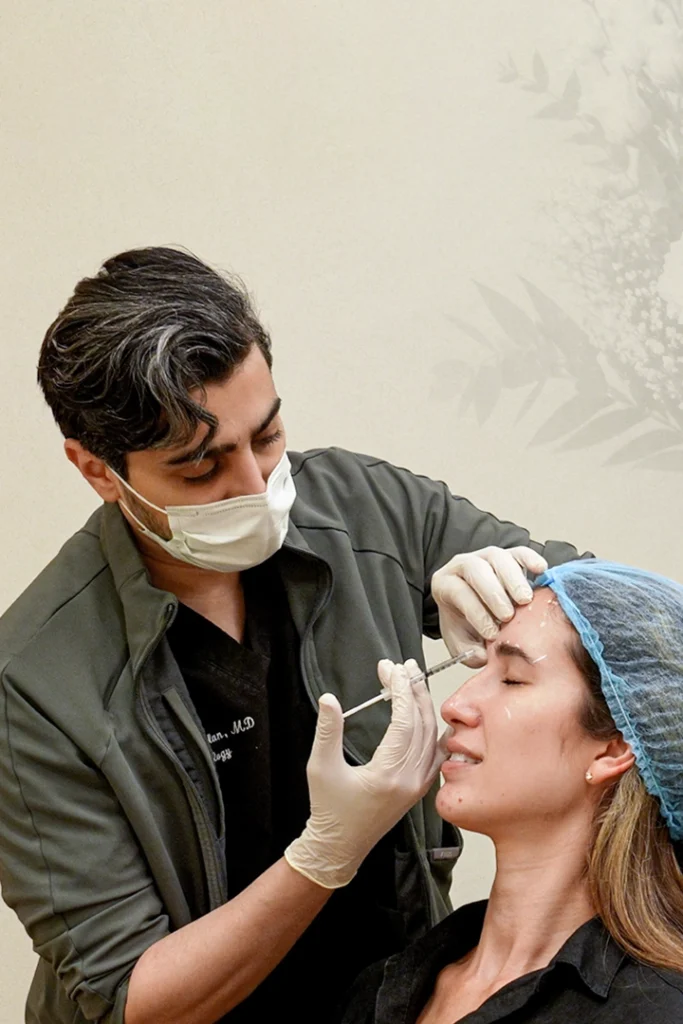
How Dermal Fillers Work
The way a filler works depends on its composition, physical characteristics, injection depth, and treatment area. Some fillers primarily provide immediate volume and structural support, while biostimulatory materials work more gradually by encouraging collagen production and tissue remodeling.
Careful placement can restore selected volume, improve transitions between facial regions, and create a more balanced appearance without unnecessarily changing the overall character of the face.
Hyaluronic Acid Fillers Explained
Hyaluronic acid dermal fillers are commonly used for facial enhancement because HA can provide volume, hydration, and structural support.
Different formulations have different levels of cross-linking, elasticity, and cohesivity, allowing the clinician to select a product according to the anatomy and purpose of treatment.
Products from established filler ranges, including Juvéderm, Restylane, Teosyal, and Belotero, may have different characteristics and applications, so product selection should be based on clinical assessment rather than brand name alone.
Collagen Stimulation & Long-Term Benefits
Some advanced dermal fillers and injectable biostimulators are designed to support collagen remodeling in addition to providing structural effects.
Materials such as calcium hydroxylapatite (CaHA) and poly-L-lactic acid (PLLA) work differently from traditional HA fillers and may gradually stimulate collagen production.
This process, often described as biostimulation or collagen neogenesis, can contribute to improvements in tissue support and skin quality over time.
Immediate vs. Progressive Results
Hyaluronic acid fillers can create an immediate change because the injected material provides physical volume and support.
However, early swelling or mild edema can temporarily affect the appearance, so the final result is better assessed after the initial healing period.
Biostimulatory treatments can produce more progressive changes because collagen remodeling develops gradually over time.
Volume Loss and the Changing Architecture of the Face
Facial aging involves more than the development of wrinkles. Changes can occur in the skin, fat compartments, connective tissues, muscles, and underlying bone, gradually altering facial volume and the transitions between different anatomical regions.
Understanding this changing facial architecture is therefore an important part of filler planning. Rather than treating every visible line individually, an anatomical approach considers where volume or support has changed and how restoring selected areas may influence the overall facial appearance.
Balance Seen in Transitions, Not Size
Natural-looking filler treatment is not necessarily about making features larger.
Facial harmony depends on how the lips relate to the chin, how the cheeks transition into the under-eye area, and how the chin and jawline relate to the nose and lower face.
Dr. Haitham’s approach considers anatomical proportions, symmetry, soft-tissue support, and facial transitions to create a result that complements the patient’s existing features rather than applying the same filler template to every face.
Dermal Filler Treatment Areas We Offer
Dr. Haitham offers personalized dermal filler treatment across a wide range of facial and hand areas. Each treatment is planned according to individual anatomy, proportions, and aesthetic goals rather than a fixed template.
Lip Filler (Lip Augmentation & Enhancement)
Lip fillers can be used to restore lost volume, enhance lip shape, improve symmetry, and define structures such as the vermillion border and Cupid’s bow. The amount and placement of filler are tailored to the patient’s natural anatomy and desired degree of enhancement, with an emphasis on maintaining proportion and natural movement.
Cheek Filler (Midface Volume & Lift)
Cheek dermal fillers can restore selected areas of midface volume and refine the contour around the zygomatic arch. Strategic placement may improve cheek definition and provide structural support to surrounding areas while maintaining a natural transition between the cheeks, under-eye region, and lower face.
Chin Filler (Chin Augmentation & Projection)
Chin filler can improve projection, definition, or selected asymmetries of the chin. Because the chin contributes significantly to facial profile and lower-face balance, treatment planning considers its relationship with the lips, nose, jawline, and surrounding soft tissues rather than treating the chin as an isolated feature.
Jawline Filler (Jawline Contouring & Definition)
Dermal fillers for the jawline can provide structural definition in carefully selected areas of the lower face. Treatment may be considered when reduced definition, age-related volume changes, or an imbalance between the chin and jawline affects facial proportions. The goal is controlled contouring rather than excessive volume.
Nose Filler / Non-Surgical Rhinoplasty
Nose filler, commonly referred to as a non-surgical rhinoplasty, can use carefully placed filler to camouflage certain contour irregularities or create the appearance of a more balanced nasal profile. Because the nose contains important blood vessels and has complex anatomy, this procedure requires particularly careful assessment and injection technique. It adds volume and cannot replace surgical rhinoplasty when structural reduction or major reshaping is required.
Tear Trough Filler (Under-Eye Hollows)
Tear trough filler may be appropriate for selected patients whose under-eye appearance is significantly influenced by volume deficiency. The tear trough is a delicate anatomical area, and not every under-eye concern should be treated with filler. Skin pigmentation, puffiness, fat prominence, bone structure, and skin quality may also contribute to the appearance of the area.
Nasolabial Fold Filler (Smile Lines)
Nasolabial fold filler can soften the appearance of folds extending from the nose toward the corners of the mouth when volume loss and structural changes contribute to their prominence. Depending on the anatomy, restoring support in nearby areas may be more appropriate than placing large amounts of filler directly into the fold.
Marionette Line Filler (Drooping Mouth Corners)
Marionette lines can become more prominent as facial volume and tissue support change with age. Filler may be considered when volume deficiency contributes to these lines, with the chin and pre-jowl sulcus also assessed as part of the overall lower-face structure.
Temple Filler (Temple Rejuvenation)
Loss of volume around the temples can create a hollowed appearance and change the transition between the forehead and cheeks. Temple filler may restore selected volume in appropriately chosen patients, although the region has complex anatomy and requires careful treatment planning.
Hand Filler (Hand Volume Restoration)
Age-related volume loss can make veins, tendons, and other structures on the hands more visible. Hand fillers can restore selected soft-tissue volume and improve the appearance of the hands when the underlying concern is appropriate for injectable treatment.
Full-Face Filler (Comprehensive Facial Rejuvenation)
Full-face filler treatment does not mean filling every facial area. Instead, it involves assessing the face as an interconnected structure and identifying the specific areas where restoring volume or support may improve overall balance. A comprehensive approach may involve treating selected areas rather than using the same amount of filler throughout the face.
Filler Dissolving / Correction (Hyaluronidase Treatment)
When a hyaluronic acid filler needs to be reduced or corrected, hyaluronidase may be used to break down HA. This can be considered for certain concerns such as overcorrection, asymmetry, migration, or complications, but the decision requires assessment of the filler used, treatment history, anatomy, and reason for correction.
What Do Dermal Fillers Treat?
Dermal fillers can address a range of volume- and structure-related concerns, but they are not a universal treatment for every sign of aging.
The appropriate approach depends on whether the concern results primarily from volume loss, muscle activity, skin laxity, pigmentation, structural anatomy, or another underlying factor.
Full Face Volume Loss
Hand Volume Loss
Nose Asymmetry or Hump Camouflage
Acne or Surgical Scars
Skin Aging & Fine Lines
Small or Aging Lips
Weak Chin and Jawline Definition
Deep Wrinkles & Folds
Benefits of Dermal Fillers
When appropriately selected and carefully performed, dermal fillers can restore localized facial volume, improve proportions, enhance lip definition, refine cheek and jawline contours, soften selected folds and depressions, and restore volume in areas such as the hands.
They can provide a non-surgical option for patients who want subtle structural changes without surgical incisions.
The degree of improvement depends on the treatment area, filler material, injection technique, and individual anatomy.
Dermal Filler Injections: Female vs. Male Approaches
Filler treatment should always be individualized, although aesthetic goals and preferred facial contours may differ between men and women.
The same injection pattern or volume should not automatically be applied to every patient.
Female: Soft, Feminine Contours
Male: Strong, Masculine Definition
Who Is a Good Candidate for Dermal Fillers?
A suitable candidate is generally someone who has a specific concern related to facial volume, contour, proportion, or selected lines and understands that fillers provide enhancement rather than a permanent transformation.
Patients should have realistic expectations and be medically suitable for the proposed treatment.
During consultation, Dr. Haitham evaluates facial anatomy, skin condition, previous treatments, medications, allergies, and aesthetic goals before determining whether dermal fillers are appropriate.
Who May Not Be Suitable for Dermal Fillers?
Dermal fillers may need to be postponed or avoided when there is an active infection or significant inflammation in the planned treatment area, certain medical or allergic considerations, or circumstances in which the expected benefits do not justify the potential risks.
Pregnancy and breastfeeding also require individual medical consideration.
Anyone with a history of previous filler complications should disclose this during consultation so the treatment plan can be adjusted appropriately.
What Happens During Your Filler Session?
A typical filler appointment may take around 30 to 60 minutes, depending on the treatment area and number of areas being addressed.
The exact duration varies according to the complexity of the procedure.
Step 1: Consultation & Facial Assessment
Step 2: Facial Mapping & Treatment Planning
Step 3: Cleansing the Area
Step 4: Application of Anesthesia
Step 5: Injecting the Dermal Filler
Step 6: Cleaning, Massaging & Follow-Up Instructions
Pre-Treatment Care: Do’s & Don’ts Before Your Filler Appointment
Before your appointment, tell Dr. Haitham about any medications, supplements, allergies, previous filler treatments, and relevant medical conditions.
Some medications and supplements can increase bruising, so these should be discussed with your clinician rather than stopped independently.
It is also preferable to postpone treatment when you have an active infection or significant inflammation near the planned injection site.
Follow any additional preparation instructions provided during your consultation.
Post-Treatment Care: Aftercare Tips for Best Results
After treatment, follow the specific instructions provided for your injection sites and filler type.
Avoid unnecessary pressure or manipulation of the treated area, strenuous exercise and excessive heat exposure for the period recommended by your clinician.
Use appropriate sun protection and avoid applying significant pressure to newly treated areas.
Mild swelling, redness, tenderness, or bruising can occur during the early recovery period.
If you experience unusual or worsening pain, significant skin discoloration, blistering, or visual symptoms, seek urgent medical assessment.
From Swelling to Stunning: Healing Timeline Explained
Swelling and tenderness are common short-term responses after filler injections, while bruising can occur depending on the treatment area and individual tendency.
These effects often improve over several days, although some areas, particularly the lips and under-eye region, can experience more noticeable temporary swelling.
The initial appearance should not be considered the final result because the filler needs time to integrate and the surrounding tissue needs to settle.
What to Expect: Outcomes After Your Dermal Filler Treatment
The outcome of treatment depends on the filler material, injection technique, treatment area, and individual anatomy.
HA fillers generally provide an immediate structural effect, although swelling can temporarily change the appearance during the first few days.
Many dermal fillers provide results for approximately 6 to 18 months, but longevity varies considerably according to the product, treatment area, metabolism, tissue movement, and individual response.
Maintenance should be considered based on the actual clinical result rather than a fixed schedule.
Filler Dissolving / Correction: When & Why It’s Needed
Filler correction may sometimes be required when a patient develops asymmetry, overcorrection, migration, an unwanted contour, or another clinical concern.
For HA fillers, hyaluronidase can be used in appropriate circumstances to break down the injected hyaluronic acid.
Correction should always begin with an assessment of the treated area and the original filler, because dissolving is not appropriate for every situation and non-HA fillers require different management.
Why Choose Dr. Haitham Al Gzlan for Dermal Fillers in Riyadh?
Choosing a provider for dermal fillers in Riyadh involves more than selecting a filler brand.
The treatment requires detailed knowledge of facial anatomy, tissue planes, vascular structures, proportions, and how injected material interacts with surrounding tissues.
Dr. Haitham’s approach emphasizes individualized facial assessment, conservative volume restoration, anatomical treatment planning, appropriate product selection, and careful injection technique.
Where clinically appropriate, filler treatment may also be incorporated into a broader facial rejuvenation plan alongside treatments such as Botox or laser procedures.
Dermal Fillers FAQs
Many dermal fillers last approximately 6 to 18 months, although some treatments may last longer or shorter. Longevity depends on the filler formulation, treatment area, amount injected, metabolism, tissue movement, and individual response.
Dermal fillers are medical aesthetic treatments and can cause side effects or complications. Temporary swelling, bruising, redness, and tenderness are common, while less common but serious complications can include infection, nodules, inflammatory reactions, or vascular occlusion. Appropriate patient selection, anatomical knowledge, sterile technique, and careful injection are important for reducing risk.
Most patients experience mild pressure, pinching, or brief discomfort during injection. Topical anesthetic and fillers containing lidocaine can help improve comfort, while the experience varies according to the treatment area and individual sensitivity.
Fillers can sometimes be combined with Botox in Riyadh or selected laser and skin-rejuvenation treatments. The appropriate combination and timing depend on the treatment areas, patient’s goals, skin condition, and clinical assessment.
Lip filler physically adds volume and can improve lip shape, projection, symmetry, and definition. A lip flip uses a neuromodulator to relax selected muscles around the upper lip, allowing the lip to turn slightly outward without adding filler volume.
HA fillers can sometimes be dissolved using hyaluronidase. However, dissolving should follow a clinical assessment because the reason for dissatisfaction, filler type, treatment area, and underlying anatomy all need to be considered.
Makeup may usually be resumed once the injection sites have settled sufficiently, but the exact timing can vary according to the treatment area and your clinician’s instructions. Avoid unnecessary pressure or rubbing over freshly injected areas.
Most filler-related reactions are temporary, but delayed swelling, nodules, inflammation, migration, infection, and other complications can occur. The long-term profile depends on the filler material, injection site, technique, and individual response. Regular assessment is important if a persistent change develops.
Yes. Dermal fillers for men can be used for selected concerns such as chin projection, jawline definition, cheek structure, facial asymmetry, or age-related volume loss. Treatment should account for individual masculine facial proportions rather than using a standardized female or male template.
The cost of dermal fillers in Riyadh varies according to the filler selected, number of syringes required, treatment area, complexity of the procedure, and whether several areas are treated. An accurate cost can only be determined after assessing your facial anatomy and establishing an individualized treatment plan.
Ready to Restore Your Youthful Glow? Book Your Dermal Filler Consultation in Riyadh
If you are considering lip fillers, cheek dermal fillers, jawline contouring, chin filler, tear trough treatment, nose filler, or full-face volume restoration, the first step is a detailed assessment of your facial anatomy and aesthetic goals.
Book a consultation with Dr. Haitham Al Gzlan in Riyadh to discuss your concerns and develop a personalized treatment plan focused on facial proportion, structural support, and natural-looking results.