
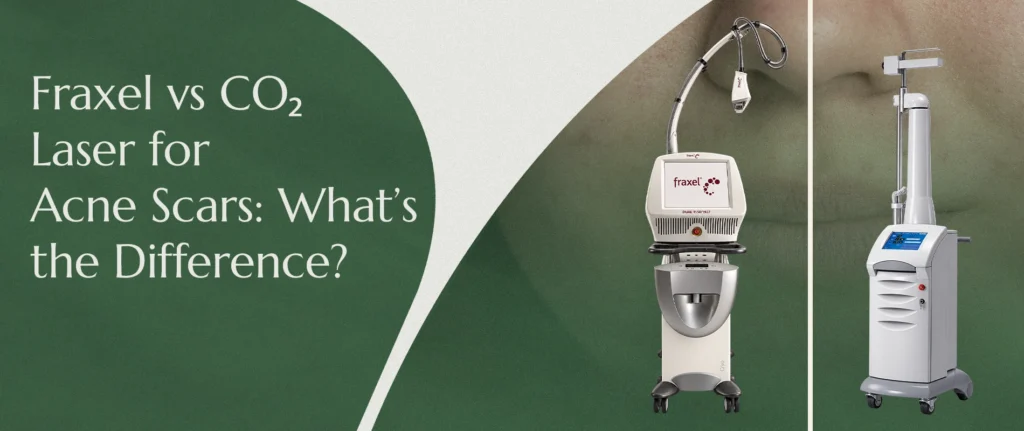
Fraxel and fractional CO₂ can both improve acne scars, but they differ in treatment intensity, skin injury, downtime, and pigmentation risk. In this article, Fraxel mainly refers to the non-ablative 1550-nm fractional wavelength used for acne scar resurfacing, while fractional CO₂ is an ablative fractional laser that removes microscopic columns of skin and heats deeper tissue. Fraxel usually offers gradual collagen remodeling with a shorter visible recovery, while fractional CO₂ provides stronger resurfacing per treatment but generally requires more healing time and carries a greater risk of pigment changes. Neither treatment is automatically better because the right choice depends on your acne scar type, scar depth, skin tone, history of post-inflammatory hyperpigmentation, available downtime, and treatment goals.
ما هو ليزر فراكسل؟
Fraxel is a brand of fractional laser technology rather than one single type of laser. For acne scars, Fraxel commonly refers to a non-ablative 1550-nm fractional laser that creates microscopic zones of controlled heat in the skin while leaving most of the surface intact. The treatment stimulates collagen production and remodeling without removing microscopic columns of the epidermis in the same way as fractional CO₂. Healthy tissue surrounding each treatment zone helps support recovery and usually allows a shorter visible healing period. Fraxel laser resurfacing may improve selected rolling scars, boxcar scars, uneven texture, and other mild-to-moderate atrophic acne scars. Different types of Fraxel also exist, including more superficial wavelengths such as 1927 nm that serve a different purpose from the deeper 1550-nm wavelength commonly used for scar remodeling.
What Is Fractional CO₂ Laser?
Fractional CO₂ is an ablative fractional laser that creates microscopic columns of controlled tissue removal while delivering heat into the surrounding dermis. The laser uses a 10,600-nm wavelength that is strongly absorbed by water in skin tissue. Because only a fraction of the treatment area receives these microscopic injuries, untreated tissue remains between them and supports faster healing than traditional full-field CO₂ resurfacing. Fractional CO₂ can stimulate significant collagen remodeling while also resurfacing uneven skin, making it useful for selected boxcar, rolling, and mixed atrophic scars. The treatment is generally more intensive than non-ablative Fraxel and can provide a stronger resurfacing effect per session. The trade-off is greater skin-barrier disruption, with more redness, swelling, crusting, peeling, and social downtime.
Fraxel vs CO₂: The Core Technical Difference
The core difference between Fraxel laser vs CO₂ is non-ablative versus ablative resurfacing. Fraxel 1550 heats microscopic columns within the skin without intentionally removing the surface tissue, while fractional CO₂ removes microscopic columns of tissue and creates surrounding thermal injury. This usually makes CO₂ more intensive per session, while Fraxel generally produces less visible injury and allows a more gradual treatment course. Both remain fractional technologies because they leave untreated tissue between treatment zones rather than resurfacing every part of the skin uniformly. The technical difference influences treatment depth, recovery time, pigmentation risk, comfort, and the number of sessions that may be needed. The table below summarizes the most important practical differences.
| الخاصية | Fraxel 1550 | ليزر CO2 الكسري |
|---|---|---|
| Laser type | Non-ablative fractional | Ablative fractional |
| Main action | Heats microscopic dermal treatment zones | Ablates microscopic columns and heats surrounding tissue |
| Surface injury | Lower | Higher |
| ندبات حب الشباب | Selected mild-to-moderate atrophic scars | Selected moderate-to-deeper atrophic scars |
| Collagen remodeling | Yes | Yes, with stronger resurfacing |
| Typical treatment approach | Often a series | Often fewer, more intensive sessions |
| Visible downtime | Usually shorter | Usually longer |
| Early recovery | Redness, swelling, dryness, bronzing or flaking | Redness, swelling, oozing/crusting, peeling |
| PIH concern | Possible | Generally greater concern with more aggressive treatment |
| Darker skin | Can be considered with careful settings | Requires more cautious selection and settings |
| Best fit | Gradual improvement with lower surface injury | Stronger resurfacing when greater recovery is acceptable |
| Final results | Develop gradually over months | Surface improvement may appear sooner, with remodeling continuing for months |
These are general clinical differences rather than guaranteed timelines or outcomes. Device settings, treatment density, scar depth, skin phototype, and individual healing can change the experience substantially.
Fraxel vs CO₂ for Acne Scars: Which Works Better?
Neither Fraxel nor fractional CO₂ works better for every acne scar. Fractional CO₂ may provide stronger improvement per session for some deeper atrophic scars, while Fraxel can provide meaningful improvement with less epidermal injury and shorter recovery. Comparative studies support both treatments for acne scarring, but the balance between results and downtime differs. Scar morphology matters just as much as laser strength because deep ice-pick scars or strongly tethered rolling scars may respond poorly to either laser alone. Treatment should therefore focus on the scar pattern rather than simply choosing the more aggressive technology. The most useful question is which treatment provides the best risk-adjusted improvement for the individual patient.
How each laser responds to different scar types
Rolling scars and shallow-to-moderate boxcar scars can improve with both Fraxel and fractional CO₂ because both stimulate collagen remodeling. Fractional CO₂ may provide stronger resurfacing when scar edges and broader texture irregularities need more aggressive correction. Tethered rolling scars may need subcision because laser energy cannot reliably release deeper fibrous attachments. Deep ice-pick scars often need focal treatments such as TCA CROSS or punch procedures rather than laser resurfacing alone. Mixed scars may therefore require several treatment mechanisms, with Fraxel or CO₂ improving broader texture while another procedure targets deep or tethered scars.
Evidence comparing Fraxel and fractional CO₂ for acne scars
Clinical evidence supports both non-ablative 1550-nm fractional lasers and fractional CO₂ for atrophic acne scars. In comparative research, fractional CO₂ has sometimes produced slightly greater improvement per treatment, but it has also caused more discomfort, crusting, and longer redness. Non-ablative 1550-nm fractional resurfacing can also improve acne scars, including in darker phototypes, although PIH remains possible. These findings suggest a trade-off rather than one universal winner. CO₂ can deliver stronger injury and potentially greater improvement per treatment, while non-ablative fractional treatment can reduce surface disruption and recovery. A dermatologist should therefore weigh scar severity, skin tone, downtime, and pigment risk together.
When combining Fraxel and CO₂ (or other modalities) makes sense
Fraxel and fractional CO₂ do not routinely need to be performed together, but a staged treatment plan can sometimes use different resurfacing intensities at different points. More often, laser resurfacing works alongside a different scar treatment because each procedure solves a different structural problem. Subcision can release tethered rolling scars, CROSS can target selected ice-pick scars, and fillers can support depressions caused by volume loss. Pigmentation may also need separate management before, during, or after scar treatment. Combination therapy should therefore solve different scar mechanisms rather than simply increase treatment intensity.
Downtime and Recovery: Fraxel vs CO₂
Fraxel usually involves less visible downtime than fractional CO₂ because it preserves more of the skin surface. Fractional CO₂ produces an ablative wound response, so early recovery is generally more noticeable and can include oozing, crusting, peeling, and longer-lasting redness. The exact timeline varies with laser settings, density, number of passes, treatment area, skin type, and individual healing. A conservative CO₂ treatment may recover faster than an aggressive protocol, while stronger Fraxel settings can produce more visible downtime than expected. Downtime should therefore be discussed as a range rather than a guaranteed number of days. Patients should plan around the treatment intensity their dermatologist actually recommends.
Fraxel recovery timeline
During the first one to two days after Fraxel, the skin may feel warm, tight, swollen, or similar to a mild-to-moderate sunburn. Over the next several days, patients may notice bronzing, dryness, rough texture, or mild flaking as microscopic treated tissue clears. Many patients plan several days of social downtime, although residual pinkness or sensitivity can persist longer. Makeup may sometimes be resumed relatively early, depending on the treatment and clinician instructions. The visible recovery phase ends well before collagen remodeling is complete. Acne scar results should therefore be judged over several months rather than immediately after treatment.
Fractional CO₂ recovery timeline
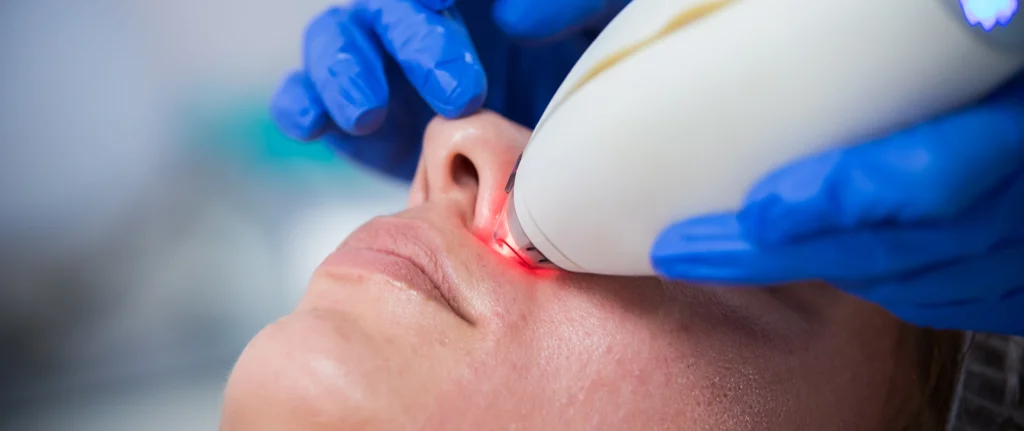
Fractional CO₂ recovery is more involved because the laser creates microscopic areas of surface ablation. During the first few days, redness, swelling, warmth, oozing, or pinpoint crusting may occur, followed by more visible peeling and crusting as the skin repairs itself. Many patients need roughly a week or longer before they feel socially comfortable, but stronger treatment can require a longer recovery window. Pinkness may continue after peeling has resolved, especially after more intensive resurfacing. The surface can therefore look healed before deeper inflammation has fully settled. Collagen remodeling then continues for several months.
How to plan work, social events, and travel around each treatment
Fraxel is generally easier to plan around a busy schedule because its visible recovery is usually shorter. Patients should still avoid scheduling weddings, professional photography, presentations, or other major events immediately after treatment because redness and swelling can persist longer than expected. Fractional CO₂ requires a larger recovery buffer, and planning only around the day peeling stops can underestimate how long redness and sensitivity remain visible. Travel also matters because hot climates, strong sun exposure, swimming, and limited access to follow-up care can complicate early recovery. Patients should ask their dermatologist how much social downtime is realistic for their exact laser settings. Personalized planning is more useful than relying on a generic Fraxel or CO₂ recovery estimate.
Safety, Skin Tone, and Pigmentation Risk
Both Fraxel and CO₂ can cause pigment changes, but pigmentation risk becomes more important as treatment intensity and inflammatory injury increase. Patients with darker skin tones or a history of PIH require careful laser selection, conservative settings, and strict photoprotection. Non-ablative Fraxel often provides more flexibility in pigment-prone skin because it causes less surface ablation. However, Fraxel is not automatically safe for every darker skin tone, and fractional CO₂ is not automatically prohibited. Scar severity, phototype, previous pigmentation, treatment density, sun exposure, and healing history all influence safety. The dermatologist should therefore balance potential improvement against the individual patient’s pigment response.
Why darker skin tones (Fitzpatrick III–VI) need special consideration
Fitzpatrick III–VI skin can develop more visible pigmentation after inflammation. Laser treatment deliberately creates controlled inflammation, so post-inflammatory hyperpigmentation becomes an important consideration when planning resurfacing. Higher laser density and greater thermal injury can increase inflammatory burden, which means the same settings should not automatically be used across all skin tones. Non-ablative 1550-nm fractional lasers have demonstrated acne-scar improvement in darker phototypes, but temporary PIH can still occur. Fractional CO₂ may also be used in selected darker skin tones, but treatment generally requires more caution. The goal is not to avoid treatment solely because of skin color, but to match treatment intensity carefully to pigment risk.
Fraxel’s advantage for skin of color
Fraxel 1550 can offer an advantage in selected darker skin tones because it creates non-ablative fractional injury rather than removing microscopic areas of the epidermis. This gives dermatologists more flexibility to use a gradual, lower-density approach when PIH risk is a major concern. Research supports the use of non-ablative 1550-nm fractional resurfacing across darker phototypes, although higher treatment density can still increase temporary hyperpigmentation. Fraxel should therefore be described as potentially lower-risk in appropriately selected skin rather than risk-free. A careful history of previous pigmentation remains essential. Conservative settings and strong sun protection also remain important.
Melasma and pigmentation history: what to disclose before treatment
Tell your dermatologist if you have melasma, prolonged dark marks after acne, pigmentation after previous procedures, or skin that darkens easily after irritation. Melasma requires particular caution because inflammation and heat can sometimes trigger worsening or recurrence. A laser having a pigmentation indication does not mean every patient with melasma is a good candidate. Previous PIH can also provide useful information about how reactive your skin may be after treatment. Your dermatologist should know about previous lasers, peels, pigmentation treatments, and sun exposure before recommending Fraxel or CO₂. This history can change both device choice and treatment intensity.
Pre- and post-treatment pigment control protocols
Pigment-control strategies may include strict sun avoidance, broad-spectrum sunscreen, conservative laser settings, and carefully selected skincare before and after treatment. Some pigment-prone patients may receive prescription topical preparation before laser treatment, but this should be individualized rather than started without medical supervision. After treatment, avoiding unnecessary heat, inflammation, picking, and early exposure to active ingredients can help reduce irritation. Pigment management should continue through recovery instead of being treated as a single pre-laser step. Follow-up is particularly useful when PIH begins to develop because early management may change the treatment plan. Every protocol should match the patient’s phototype and treatment intensity.
Pain, Comfort, and Number of Sessions
Fraxel generally causes less discomfort and requires less recovery than fractional CO₂, although both treatments commonly use numbing measures. Fraxel often requires more sessions because each treatment is less ablative, while fractional CO₂ may produce a stronger response in fewer treatments. The exact number of sessions cannot be predicted from the laser name alone because scar depth, settings, treatment response, and combination therapy all affect the plan. Pain also varies with treatment density, energy, area, and individual sensitivity. More intensive treatment is not automatically better if it creates unnecessary recovery or pigment risk. Comfort and session planning should therefore be individualized.
What each treatment feels like and how discomfort is managed
Fraxel often feels like repeated heat, prickling, or stinging during treatment. Topical anesthetic and cooling commonly make the procedure easier to tolerate. Fractional CO₂ generally feels more intense because of the additional ablative injury, and clinicians may use topical anesthesia, local anesthesia, cooling, or other pain-control measures depending on treatment strength. Heat or a sunburn-like sensation can continue for some time after either procedure. Discomfort should gradually improve during recovery rather than worsen. Severe or progressively increasing pain should be reported to the treating dermatologist.
Typical number of sessions for acne scars
Fraxel treatment commonly involves a series of sessions because improvement builds gradually through repeated collagen remodeling. Many treatment plans use several sessions spaced weeks apart, but there is no universal 3–5 session requirement for every acne scar. Fractional CO₂ may require fewer treatment sessions because each procedure can deliver more intensive resurfacing. However, deeper or mixed scars may still need repeat treatment or additional procedures such as subcision, CROSS, or fillers. A dermatologist should reassess response after each session rather than commit every patient to a fixed package in advance. Treatment number should follow clinical progress.
Why more sessions sometimes means a gentler, safer journey
More treatments do not automatically mean an inferior treatment plan. In pigment-prone skin, several conservative sessions can sometimes produce useful cumulative improvement with less inflammatory stress per procedure. Fraxel illustrates this approach well because lower surface injury may require more sessions but also allows the dermatologist to observe healing before increasing treatment intensity. A more aggressive CO₂ session may shorten the treatment course but creates a larger recovery burden. Some patients prefer gradual progress because it fits work, social life, and pigmentation risk better. The safest journey is the one that achieves meaningful improvement without unnecessary complications.
Results: What Improvement Can You Expect?
Both Fraxel and fractional CO₂ can improve selected atrophic acne scars, but neither can promise complete scar removal. Fraxel typically delivers gradual improvement through repeated collagen remodeling, while fractional CO₂ may create a larger visible change per treatment because it combines ablation with thermal remodeling. The final result depends heavily on scar morphology rather than laser choice alone. Deep ice-pick scars, severe tethering, and significant volume loss may remain visible even after successful laser treatment. Meaningful improvement should therefore be measured by smoother texture, softer scar edges, and reduced scar visibility. Realistic expectations help patients avoid unnecessarily aggressive treatment.
Fraxel results timeline: gradual improvement over 3–6 months
Fraxel results develop gradually because collagen remodeling continues long after redness and flaking have resolved. Patients may notice early texture improvement within weeks, but the deeper scar response can continue developing over approximately three to six months. When several sessions are performed, each treatment can add to the cumulative response. Temporary swelling immediately after treatment can make scars look smoother before the real structural improvement develops. Final evaluation should therefore occur after adequate remodeling rather than immediately after the last session. Consistent photographs taken under similar lighting can help track progress more accurately.
Fractional CO₂ results timeline: faster visible change but longer healing
Fractional CO₂ can create more noticeable early surface change once peeling and crusting resolve. However, the final result still takes months because deeper collagen remodeling continues after the epidermis has healed. The main distinction is that CO₂ often produces more immediate surface resurfacing alongside longer-term collagen improvement. Stronger early change comes with greater visible healing and more intensive aftercare. Faster visible improvement should therefore not be confused with faster recovery. Patients should assess the full result only after both surface healing and deeper remodeling have had time to occur.
Factors that influence results: scar depth, skin type, adherence to aftercare
Scar depth, shape, density, tethering, laser settings, treatment frequency, and individual healing all influence results. Skin type affects the level of treatment the skin can safely tolerate and the likelihood of PIH. Sun exposure, picking, poor wound care, and premature use of irritating skincare can prolong inflammation and compromise recovery. Active acne can also create new scars while older ones are being treated. Combination therapy may be necessary when some scars respond poorly to laser alone. Good aftercare supports the result, but accurate scar selection remains the most important starting point.
Why realistic expectations matter for both options
Laser resurfacing improves acne scars rather than completely erasing them. Expectations matter because trying to achieve perfectly smooth skin can encourage unnecessarily aggressive settings or repeated procedures with diminishing benefit. Some scars will respond better to another technique, while others may improve substantially but remain visible in certain lighting. The safest treatment plan defines what meaningful improvement looks like before treatment starts. Patients should also understand that skin continues to age and can develop new acne or pigmentation after treatment. A realistic goal is noticeable improvement with healthy skin and an acceptable recovery.
Risks and Side Effects: Fraxel vs CO₂
Both Fraxel and fractional CO₂ can cause temporary redness, swelling, warmth, dryness, peeling, and pigment changes. Fraxel generally causes less surface disruption and therefore has a lighter recovery profile, while fractional CO₂ creates a stronger wound response and requires more intensive aftercare. Less common but important risks include infection, herpes reactivation, prolonged redness, hypopigmentation, hyperpigmentation, delayed healing, and additional scarring. The chance of complications depends on treatment intensity, skin type, provider experience, and aftercare. Patients with darker skin or previous PIH need especially careful planning. Risk discussions should be part of the consultation before treatment is booked.
Common short-term side effects for both
Both treatments commonly produce redness, swelling, heat, tenderness, and temporary changes in skin texture. Fraxel often causes bronzing, dryness, or mild flaking, while fractional CO₂ can produce more obvious crusting, oozing, peeling, and sensitivity. These reactions should gradually improve during recovery. The amount of downtime depends on treatment settings and individual healing rather than the device name alone. Patients should receive clear instructions about which reactions are expected. They should also know which symptoms require earlier medical review.
Redness, swelling, dryness, and temporary pigment change
Redness and swelling usually appear soon after treatment, followed by dryness, rough texture, peeling, or crusting during early healing. Temporary darkening can occur after either Fraxel or CO₂, particularly in pigment-prone skin. The stronger the inflammatory response, the more closely pigmentation should be monitored. Some residual redness can remain after the skin surface appears healed. Strict sun protection is especially important during this period. Persistent or worsening pigmentation should be discussed with the treating dermatologist.
Fraxel-specific risks
Fraxel causes less ablative injury but can still produce PIH, prolonged redness, irritation, acneiform eruptions, or herpes reactivation. The risk depends on treatment density, energy, phototype, sun exposure, and previous pigment history. Higher treatment intensity can increase inflammation even though the surface remains largely intact. Some patients may also experience unexpected sensitivity or a temporary flare of underlying skin concerns. Fraxel should therefore remain a medical laser procedure rather than being treated like a no-risk facial. Proper screening and aftercare still matter.
Prolonged redness, herpes reactivation, and rare pigment changes
Some patients experience redness longer than expected after non-ablative fractional resurfacing. Laser treatment can also reactivate herpes simplex in susceptible patients, especially when treating areas around the mouth. Temporary hyperpigmentation can occur, and unwanted lightening is possible but less common. Patients with previous cold sores should disclose this history before treatment because antiviral medication may be considered. Persistent redness or pigment change should be reviewed rather than ignored. Early assessment can help distinguish normal recovery from a developing complication.
Fractional CO₂-specific risks
Fractional CO₂ creates greater epidermal disruption and therefore carries a more intensive recovery and complication profile. PIH, prolonged erythema, infection, crusting, delayed healing, and pigment changes deserve particular attention. Very aggressive treatment, inappropriate settings, or poor wound care can also cause additional scarring. These risks do not make CO₂ a poor treatment because appropriate patients can achieve meaningful improvement. They do mean that patient selection and provider experience are especially important. Darker skin tones require more careful risk-benefit assessment before treatment.
Higher PIH risk, prolonged erythema, infection, and scarring if aftercare is poor
Greater inflammatory injury makes PIH an important consideration after fractional CO₂, especially in darker or pigment-prone skin. The temporarily disrupted skin barrier also increases susceptibility to bacterial or viral infection. Redness can remain after peeling has finished, and some patients experience longer-lasting erythema. Picking crusts, failing to protect the skin from sun, or applying irritating products too early can increase complications. Poor wound care can also delay healing. Patients should contact their dermatologist if recovery becomes more painful, inflamed, or abnormal instead of gradually improving.
How to minimize risks: experienced provider, conservative settings, strict aftercare
Choose a dermatologist who understands scar morphology, laser physics, skin phototypes, and complication management. The most effective treatment is not necessarily the highest possible energy setting, and conservative parameters can be increased later when the skin responds safely. Follow wound-care, cleansing, moisturizing, and photoprotection instructions carefully. Patients should avoid picking, unnecessary heat exposure, and restarting strong active skincare too early. Follow-up appointments allow the next treatment to be adjusted if PIH, prolonged redness, or slow healing develops. Good provider judgment and disciplined aftercare work together to reduce avoidable risk.
How to Choose Between Fraxel and CO₂ for Your Acne Scars
Choose between Fraxel and fractional CO₂ by balancing the scar pattern, desired improvement, pigmentation risk, and recovery you can realistically accommodate. Fraxel often suits patients who want gradual non-ablative resurfacing and less visible downtime, while fractional CO₂ may suit patients with more significant atrophic texture who can safely tolerate a stronger treatment and longer recovery. Neither choice should be based only on which device sounds more advanced. Scar morphology and skin phototype matter more than marketing language. A dermatologist should identify the scars first and choose the treatment second. This approach improves both safety and the likelihood of a useful result.
Choose Fraxel if you:
Fraxel may suit patients whose acne scars can respond to gradual collagen remodeling without the need for aggressive surface ablation. It can also make sense when shorter downtime or greater caution around pigmentation matters. Patients should still expect a treatment course rather than assume one Fraxel session will remove acne scars. The 1550-nm Fraxel laser wavelength is the more relevant option for acne scar remodeling compared with the more superficial wavelengths in the Fraxel family. Skin tone, scar type, and recovery preferences should all support the decision. Fraxel should be chosen because its treatment profile fits the patient, not simply because it sounds gentler.
Have mild to moderate scars, limited downtime, or darker skin tone
Fraxel may be considered for selected mild-to-moderate rolling and boxcar scars when minimizing ablative injury is important. It can also provide a useful option for some patients with darker skin tones because treatment intensity can be kept conservative. However, PIH remains possible, especially with higher treatment density. Skin color alone should never determine treatment because scar severity, pigmentation history, sun exposure, and previous procedures also matter. Patients with darker skin should ideally be treated by a dermatologist experienced in laser procedures for skin of color. This reduces the risk of using unnecessarily aggressive settings.
Prefer a gradual, lower-risk approach with more sessions
Fraxel suits patients who would rather accept more sessions in exchange for a lighter recovery after each treatment. This approach can be useful when the dermatologist wants to observe pigment response before increasing treatment intensity. Gradual treatment does not mean ineffective treatment because cumulative collagen remodeling can still produce meaningful scar improvement. More sessions can also be easier to schedule around work and social commitments. The trade-off is a longer overall treatment journey. The goal is steady improvement at an acceptable level of risk.
Choose fractional CO₂ if you:
Fractional CO₂ may suit patients who need stronger resurfacing for selected moderate-to-severe atrophic acne scars. It can provide more intensive collagen remodeling and surface renewal per treatment than a non-ablative approach. Patients need to understand that stronger resurfacing also creates more visible healing and a greater commitment to aftercare. Skin phototype and PIH history should be reviewed carefully before treatment. Deeper scars do not automatically mean CO₂ is the right answer because tethering or ice-pick morphology may require another procedure. The treatment should match the scar structure rather than severity alone.
Have deeper, more severe scarring and can tolerate 5–10 days of downtime
Patients with deeper or more pronounced boxcar and rolling scars may benefit from fractional CO₂ when scar morphology supports resurfacing. A planning window of approximately five to ten days may be reasonable for some fractional treatments, but it is not a guaranteed recovery period. More intensive CO₂ treatment can require longer before crusting, peeling, and redness become socially acceptable. Residual pinkness may continue beyond the initial downtime. Patients with important events should therefore allow extra recovery time rather than scheduling treatment too close to them. The exact timeline should come from the treating dermatologist.
Want more dramatic improvement in fewer sessions and accept higher PIH risk
Fractional CO₂ may produce a stronger change per treatment because it combines tissue ablation with thermal remodeling. Some patients therefore need fewer laser sessions than they would with gentler non-ablative treatment. However, greater intensity does not guarantee a better final result for every scar. The patient must accept more visible recovery, stricter wound care, and a higher concern for PIH. Deep ice-pick scars and tethered scars may still need other procedures even after CO₂ resurfacing. The decision should balance potential benefit against downtime and risk.
Consider a staged or combination plan if you:
A staged plan may be better when the skin has several scar types or both texture and pigmentation concerns. Laser resurfacing can address broad texture while focal procedures treat scars that respond poorly to laser alone. Treatment stages also let the dermatologist evaluate healing before adding more inflammatory procedures. This approach can be especially useful when pigment risk limits how aggressively the skin should be treated at one time. Staging can also help separate scar correction from pigment treatment. The aim is precision rather than simply doing more procedures.
Have mixed scar types, pigmentation, and texture concerns
Many patients have rolling, boxcar, and ice-pick scars alongside PIH or residual redness. One Fraxel or CO₂ treatment cannot optimally address every one of these concerns. Subcision, CROSS, fillers, pigment-directed treatment, or other procedures may therefore be incorporated into the acne scar treatment plan. Each modality should have a specific target rather than simply adding more technology. Pigment and structural treatment may also need to be separated to reduce inflammatory burden. This type of combination planning is often more effective than repeatedly using one laser across every scar.
Scar mapping, skin phototype assessment, and personalized planning
Scar mapping identifies the depth, shape, tethering, and distribution of individual acne scars. Phototype assessment helps estimate how carefully laser intensity needs to be controlled because of pigmentation risk. The dermatologist should also review active acne, medications, previous isotretinoin exposure, cold sores, sun exposure, previous procedures, and wound-healing history. These details influence whether Fraxel, fractional CO₂, another procedure, or a combination makes the most sense. For patients considering Fraxel or CO₂ laser treatment in Riyadh, this individualized assessment is more valuable than choosing a laser from marketing claims or before-and-after photographs. Local relevance belongs mainly at this consultation stage rather than throughout the educational content.
Preparing for Your Laser Treatment
Preparation starts with controlling significant active acne and reviewing your medical and treatment history. Tell your dermatologist about prescription and over-the-counter acne treatments, retinoids, previous isotretinoin use, chemical peels, previous lasers, pigmentation problems, cold sores, and any tendency toward keloid or hypertrophic scars. Avoid unnecessary tanning and intense sun exposure before treatment because inflamed or recently tanned skin may have a higher risk of pigment complications. Your dermatologist may also ask you to temporarily adjust certain skincare products or medicines depending on the planned procedure. Patients with a history of herpes simplex may need preventive antiviral medication, while selected pigment-prone patients may receive an individualized pre-treatment pigmentation strategy. Do not stop prescription medicines or start aggressive pre-laser skincare without medical guidance.
الأسئلة الشائعة حول Fraxel vs CO₂ for Acne Scars
Neither is universally better. Fraxel may suit patients who want gradual improvement with less surface injury, while fractional CO₂ may provide stronger resurfacing for selected deeper acne scars.
Fraxel 1550 can offer a useful non-ablative option for darker skin tones, but PIH can still occur. The safest approach depends on phototype, treatment density, pigmentation history, and provider experience.
They can potentially form part of the same treatment strategy, but performing both during one session is not automatically better. A staged approach may make more sense when limiting inflammation or treating different scar features separately.
Visible crusting and peeling may settle within roughly a week or longer after some fractional CO₂ treatments, but healing depends strongly on intensity and individual response. Redness and sensitivity can remain after the skin surface has re-epithelialized.
No. Deep ice-pick scars, tethered rolling scars, raised scars, and scars associated with substantial volume loss may need CROSS, subcision, fillers, injections, or scar surgery instead of laser alone.
Both can cause heat, stinging, or prickling, and clinicians commonly use topical anesthesia and cooling to improve comfort. Fractional CO₂ generally produces more intense treatment and post-procedure sensations than non-ablative Fraxel.
Fraxel produces gradual improvement over several months, often across a series of treatments. Fractional CO₂ may create earlier visible surface change after healing, but deeper collagen remodeling still continues for months.
Yes. A dermatologist may move from Fraxel to fractional CO₂ if your remaining scars are suitable for stronger resurfacing and your skin has responded well to previous treatment. The decision should depend on remaining scar structure, skin tone, and risk rather than simply wanting a stronger procedure.
خاتمة
Fraxel and fractional CO₂ are both fractional laser technologies, but they create different levels of skin injury and therefore offer different balances between scar improvement, downtime, and risk. For acne scars, Fraxel commonly refers to the non-ablative 1550-nm wavelength, which stimulates collagen remodeling while preserving more of the skin surface. Fractional CO₂ is ablative and creates stronger resurfacing through microscopic tissue removal and thermal remodeling. Fraxel may suit selected mild-to-moderate acne scars, patients seeking less visible downtime, and some pigment-prone skin types, while fractional CO₂ may offer stronger resurfacing for deeper atrophic scars when the patient can tolerate more recovery and higher pigmentation risk. Neither laser can treat every acne scar, so deep ice-pick scars, tethering, volume loss, pigmentation, and mixed scar patterns may require other procedures or a staged combination plan. The best Fraxel vs CO₂ laser decision is therefore not about finding the strongest device; it is about matching treatment intensity to scar type, skin phototype, recovery tolerance, and realistic goals.