
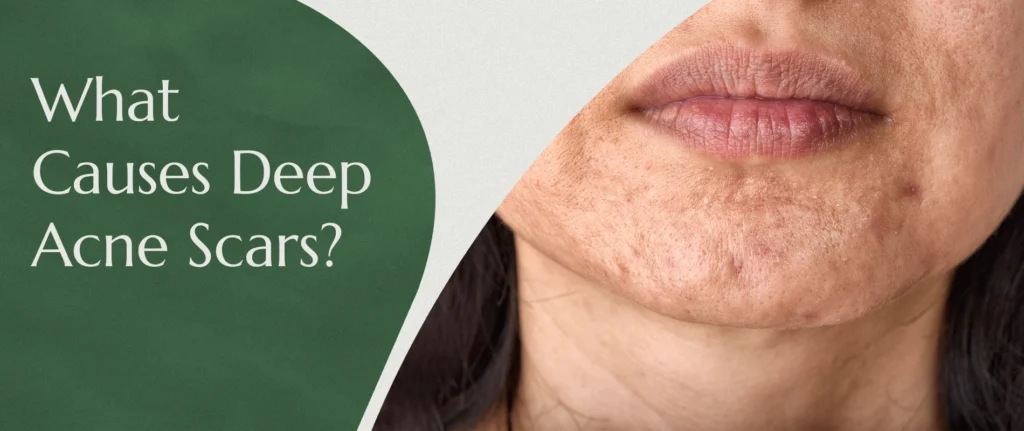
Deep acne scars form when inflammatory acne damages collagen and supporting tissue in the deeper layers of the skin. Nodules, cyst-like lesions, and prolonged inflammatory breakouts carry the greatest risk because they extend further into the dermis than superficial acne. As the skin heals, it may replace damaged tissue unevenly, leaving pits, depressions, or tethered areas. Ice pick, boxcar, and rolling scars are the main types of deep atrophic acne scars. Genetics, delayed treatment, repeated picking, and individual wound healing can increase the likelihood of deeper scarring. The key relationship is simple: deeper inflammation causes more dermal damage, and greater dermal damage increases the risk of structural acne scars.
What Are Deep Acne Scars?
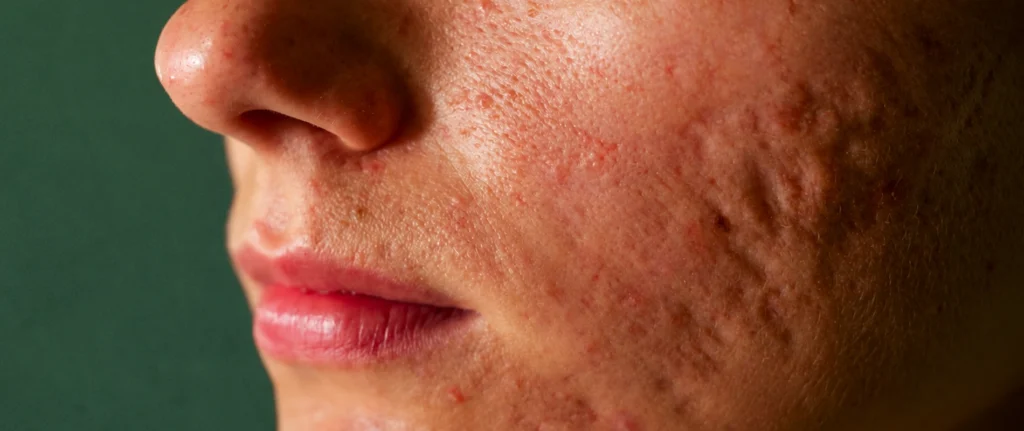
Deep acne scars are structural changes in the skin caused by tissue damage during the healing of inflammatory acne. They usually appear as pits, depressions, uneven contours, or areas that seem pulled downward rather than as flat changes in color. Most are atrophic scars, meaning the healing process leaves less supporting tissue than the skin originally had. Ice pick scars can extend deeply into the dermis, while boxcar and rolling scars can affect broader areas of skin. Deep scars may also coexist with pigmentation, making the affected area look darker as well as uneven. Because the problem involves skin structure, creams used for pimple marks removal cannot fully correct established deep scar tissue.
How deep scars differ from surface-level marks (PIH/PIE)
Deep acne scars change the skin’s texture, while PIH and PIE mainly change its color. Post-inflammatory hyperpigmentation usually appears as a flat brown or grey-brown mark, while post-inflammatory erythema appears red or pink. If the area feels smooth but looks discolored, it is more likely to be an acne mark than a structural scar. Acne pits, pimple holes, and visible depressions indicate deeper tissue alteration. A single acne lesion can leave both pigmentation and a scar, so dermatologists assess color and texture separately.
How Do Deep Acne Scars Form?
Deep acne scars form when acne inflammation extends into the dermis and disrupts normal collagen repair. During a severe breakout, inflammatory activity can damage collagen fibres and surrounding tissue. If healing results in a net loss of collagen and dermal support, the skin can sink inward and form an atrophic scar. If the body produces excessive scar tissue instead, a hypertrophic or keloid scar can develop. Nodulocystic acne is especially likely to scar because the inflammatory process penetrates deeper into the skin. The final scar therefore reflects both the depth of the original injury and the way the skin heals afterward.
The role of inflammation and collagen damage
Inflammation drives deep acne scarring because it can damage collagen within the dermis. When the body removes more collagen than it replaces during healing, the skin loses support and an atrophic depression may remain. Fibrous scar tissue can also form underneath some lesions and pull the skin downward. Nodules and cyst-like acne lesions are more likely to cause this type of damage because they develop deeper than surface pimples. Controlling severe inflammatory acne early can therefore reduce the opportunity for permanent collagen injury.
Why some breakouts scar and others don't
Not every breakout scars because acne lesions differ in depth, duration, inflammation, and individual healing response. A small whitehead or blackhead usually causes less tissue injury than a deep, painful nodule. Some people also have a greater biological tendency toward scarring because of genetics and wound-healing differences. Picking or squeezing a lesion adds mechanical trauma and can turn a limited breakout into a more inflamed wound. Scarring therefore depends on the acne itself, how the skin heals, and whether additional injury occurs.
Types of Deep Acne Scars
The main types of deep atrophic acne scars are ice pick scars, boxcar scars, and rolling scars. Dermatologists separate these scar types because each has a different shape, depth, and underlying structure. Many people with scarred acne skin have more than one type at the same time. Ice pick scars are narrow and deep, boxcar scars are wider with more defined edges, and rolling scars create broad uneven contours. Raised pimple scars can also occur, but hypertrophic and keloid scars follow a different healing pattern from atrophic pits. Correctly identifying the scar type helps determine which treatment is most appropriate.
Ice Pick Scars
Ice pick scars are narrow, deep acne pits that extend downward into the dermis. They usually look like small punctures with an opening that is much narrower than the depth of the scar. DermNet describes them as V-shaped scars that can extend into the deep dermis or subcutaneous tissue. Their depth makes them difficult to improve with superficial treatments alone. Ice pick scars often require focused scar treatment rather than general skincare or broad surface resurfacing.
Boxcar Scars
Boxcar scars are round or oval depressions with relatively clear, defined edges. They vary in depth, so some look shallow while others create more obvious facial pits or crater-like depressions. Unlike ice pick scars, they are usually wider at the skin surface. The deeper the boxcar scar, the more difficult it may be to improve with superficial treatment alone. Treatment selection should therefore consider both scar width and depth rather than grouping all boxcar scars together.
Rolling Scars
Rolling scars create broad, shallow depressions that give the skin a wavy or uneven appearance. Fibrous bands beneath the skin often tether the surface downward and contribute to this pattern. These scars may look different when the skin is stretched because the underlying attachments affect contour. Surface resurfacing alone may not address significant tethering. Treatment may therefore combine collagen remodeling with procedures that release deeper scar bands.
What Causes Some People to Scar More Deeply Than Others?
Some people develop deeper acne scars because scar formation depends on acne severity, inflammation, genetics, wound healing, treatment timing, and additional skin trauma. Nodular and cyst-like acne carries a greater risk than superficial acne because the inflammatory process extends deeper into the skin. Repeated picking or squeezing can increase tissue damage and prolong healing. Family history can also suggest a greater personal tendency toward scar formation. Skin tone affects pigmentation and procedure planning more than it directly determines scar depth. These factors explain why two people with similar acne can develop very different degrees of scarring.
Severity and type of acne (cystic/nodular vs. surface acne)
Deep nodules and cyst-like acne lesions are more likely to scar than superficial blackheads and whiteheads. These lesions extend deeper into the skin and create a stronger inflammatory response. The deeper the inflammation, the greater the opportunity for collagen and dermal tissue damage. AAD guidance notes that acne nodules and cysts penetrate deeply and commonly leave permanent scars. Recurrent cystic acne scarring is therefore a reason to seek treatment before more deep scars develop.
Delayed or inadequate treatment
Delayed treatment can allow severe inflammatory acne to remain active and create additional scars. Every new deep lesion represents another opportunity for dermal injury and abnormal wound healing. This does not mean every untreated pimple will scar, but ongoing nodular or cyst-like acne increases cumulative risk. Treating acne early can reduce the number of severe lesions and may help prevent additional scarring. Patients who are already developing acne pits should not wait for scars to become widespread before seeking professional care.
Picking, popping, or squeezing
Picking, popping, and squeezing can worsen acne scarring by increasing inflammation and physically damaging surrounding tissue. Manipulating a lesion may also prolong healing and contribute to both pigmentation and structural scar formation. Deep inflammatory pimples are especially unsuitable for home extraction because much of the lesion lies beneath the surface. DermNet specifically identifies picking and squeezing as factors that can exacerbate acne scarring. Allowing appropriate acne treatment to control the lesion is safer than repeatedly traumatizing it.
Genetics and family history
Genetics can influence how likely someone is to develop significant acne scarring. The AAD notes that people have a greater risk when a close blood relative had deep, painful acne that left permanent scars. Genetic influence may involve inflammatory response, collagen repair, and individual wound-healing tendencies. Family history cannot predict exactly how many scars someone will develop. However, a strong tendency toward deep acne and scarring makes early acne control especially important.
Skin type and Fitzpatrick considerations
Fitzpatrick skin type matters mainly for pigment changes and treatment safety rather than acting as a direct measure of scar depth. Darker skin tones may develop more noticeable post-inflammatory hyperpigmentation around scars or after skin injury. This can make pitted scarring appear more prominent because texture and pigment changes occur together. Higher epidermal melanin can also affect the choice and settings of some laser procedures. Dermatologists should therefore assess scar structure and skin tone separately when planning treatment. This approach helps improve scars while minimizing avoidable pigment complications.
Why Deep Scars Don't Improve on Their Own
Deep acne scars usually persist because the original inflammation has already changed the structure of the dermis. The body can remodel scar tissue gradually, so some scars may soften or look less obvious with time, but established pits rarely refill completely on their own. Topical skincare can improve pigmentation and surface quality but cannot reliably replace substantial tissue loss or release tethering beneath the skin. Some scars can also become more noticeable as normal age-related changes reduce collagen and skin support. Pigmentation around a scar can increase visual contrast and make the depression look deeper than it actually is. This is why established deep scars often need procedures that target the structural problem directly.
Collagen loss over time
Deep scars persist because the original acne lesion altered collagen and supporting tissue during healing. It is more accurate to say that the skin healed with structural loss or abnormal remodeling than to say that scar collagen simply keeps disappearing over time. Natural remodeling may soften a scar, but significant pitted scarring usually does not refill completely without treatment. Normal ageing can reduce overall dermal support and make some existing depressions appear more noticeable. Scar procedures therefore aim to stimulate remodeling, release tethering, or improve contour rather than waiting for spontaneous tissue replacement.
Sun exposure and hyperpigmentation making scars more visible
Sun exposure does not create the structural depression of an acne scar, but it can worsen pigmentation around it. Post-inflammatory hyperpigmentation may become darker or more persistent after light exposure, especially in pigment-prone skin. This added contrast can make scars on the face look deeper or more noticeable. Daily photoprotection therefore supports scar management even though sunscreen cannot remove pitted scars. Treating color and texture as separate concerns produces a clearer treatment strategy.
Treatments for Deep Acne Scars
Deep acne scar treatment usually requires procedures because pitted scars involve structural changes below the skin surface. The best treatment depends on scar type, depth, tethering, skin tone, active acne, previous procedures, and acceptable downtime. Fractional CO₂ resurfacing and RF microneedling can stimulate collagen remodeling in selected scars, while pigment-focused treatment can address discoloration that remains around them. No single laser treatment for scars works equally well for every ice pick, boxcar, or rolling scar. The AAD notes that dermatologists often combine treatments to improve results because patients commonly have mixed scar patterns. Treatment should aim for meaningful improvement rather than promise complete removal.
Fractional CO2 / Ultra Pulse Laser
Fractional CO₂ resurfacing creates microscopic treatment zones that stimulate wound healing and collagen remodeling. It may improve selected atrophic and textural scars, particularly when broader surface irregularity is part of the problem. UltraPulse is a CO₂ laser platform that can deliver ablative fractional treatment, but the device name alone does not determine whether it is appropriate for a particular scar. Ablative resurfacing can involve significant downtime and may cause prolonged redness, infection, or pigment changes. Darker skin tones need especially careful patient selection, settings, and aftercare because post-inflammatory hyperpigmentation can occur.
RF Microneedling (Secret RF)
RF microneedling combines fine needles with radiofrequency energy delivered into selected layers of the skin. The controlled injury stimulates collagen and elastin remodeling and can make appropriate acne scars less noticeable. Secret RF is one platform that uses this treatment principle, but results still depend on scar type, depth, and device settings. The AAD states that radiofrequency microneedling can be used across skin tones, making it a useful consideration when pigment risk affects treatment planning. It may also be combined with other scar treatments when one procedure cannot address all scar types.
PicoWay for post-scar pigmentation
PicoWay is more relevant when pigmentation remains around acne scars than when the main problem is deep structural tissue loss. Pigment-directed laser treatment may help make discoloration less noticeable in appropriately selected patients. However, reducing pigmentation does not refill an ice pick scar, release a tethered rolling scar, or replace lost dermal tissue. A patient with both pitted scarring and pigmentation may therefore need separate treatment strategies for color and texture. Skin tone, pigment type, treatment settings, and previous responses all influence whether a pigment-focused laser is appropriate.
Can Deep Acne Scars Be Prevented?
Many deep acne scars can be prevented or limited by treating inflammatory acne before repeated dermal injury occurs. Early treatment is particularly important for nodules, cyst-like lesions, recurrent inflammatory acne, and breakouts that have already begun to scar. Avoid picking or squeezing because additional trauma can increase inflammation and tissue damage. Consistent acne treatment is more effective for scar prevention than waiting until every lesion has already healed with a pimple scar. AAD guidance emphasizes that treating acne early can reduce the risk of permanent scarring. Prevention cannot guarantee that no scars will form, but reducing severe inflammation is one of the most important steps patients can control.
When to See a Dermatologist About Deep Scarring
See a dermatologist when acne leaves visible pits, deep depressions, rolling contours, or raised scar tissue. Professional assessment is especially useful if active acne is still creating new scars, because controlling the disease usually comes before intensive scar correction. A dermatologist can identify ice pick, boxcar, rolling, hypertrophic, and mixed scar patterns and look for tethering, pigmentation, and volume loss. Scar depth, skin tone, previous treatments, downtime preferences, and realistic goals influence which procedures make sense. Deep acne scars often respond better to a planned combination of treatments than to repeatedly using one device across the entire face. An accurate scar assessment therefore helps match treatment to structure rather than simply treating everything labelled an “acne scar.”
Conclusion
Deep acne scars form when inflammatory acne damages the dermis and disrupts normal collagen repair. Nodules, cyst-like lesions, prolonged inflammation, picking, delayed treatment, and individual healing tendencies can increase the risk. Ice pick, boxcar, and rolling scars differ in depth and structure, so they often need different treatment approaches. Established deep scars usually persist because the skin has healed with a structural change rather than a temporary mark. Fractional resurfacing, RF microneedling, and other scar-specific procedures can improve appropriate scars when selected carefully. The most effective long-term strategy combines prevention of new scars with treatment matched to the morphology of existing ones.
FAQs
Deep acne scars are more difficult to treat than flat marks because they involve changes in dermal structure. Results depend on scar type, depth, skin tone, active acne, previous procedures, and individual healing response. Mixed scars often need more than one technique because a treatment that helps one scar type may do little for another. Session numbers therefore vary considerably rather than following one standard treatment course. Patients with darker skin tones can still receive scar treatment, but pigment risk should influence procedure selection and settings. Realistic expectations are an important part of successful acne scar treatment.
Deep acne scars can often become less noticeable, but complete removal cannot be guaranteed because established scars involve permanent structural changes in the skin.
Treatment usually aims to improve scar depth, contour, and overall appearance rather than recreate completely scar-free skin.
There is no fixed number of sessions because treatment frequency depends on scar type, depth, procedure, skin response, and whether combination therapy is needed.
A dermatologist can estimate a treatment course after examining the scars, but deep mixed scarring often requires staged treatment.
Generally, yes. Deep scars involve greater structural change and may also include tethering or substantial tissue loss.
They can still improve, but scar-specific procedures or combination treatment are often required instead of superficial skincare alone.
Yes, several acne scar treatments can be used in darker skin tones when the procedure and settings are selected carefully.
The AAD states that microneedling and radiofrequency microneedling can be used across skin tones, while pigment risk should be considered when planning laser resurfacing.