
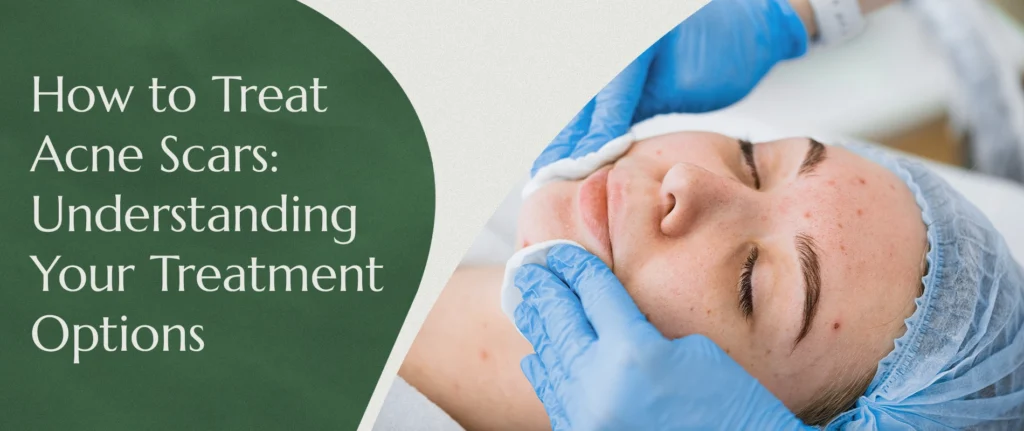
Acne scars can often be improved significantly, but no single treatment works best for every scar. The right acne scar treatment depends on the scar type, depth, tethering, skin tone, pigmentation risk, active acne, recovery tolerance, and treatment goals. Ice-pick, boxcar, rolling, hypertrophic, and keloid scars form through different structural changes, so they should not all receive the same procedure. Treatments for atrophic scars may include subcision, microneedling, RF microneedling, fractional laser resurfacing, dermal fillers, TCA CROSS, chemical peels, and selected punch techniques. Raised scars require a different approach because they result from excessive rather than insufficient collagen. The goal is meaningful improvement in scar depth, texture, and visibility rather than a guarantee of complete acne scar removal.
What Are Acne Scars and Why Do They Form?
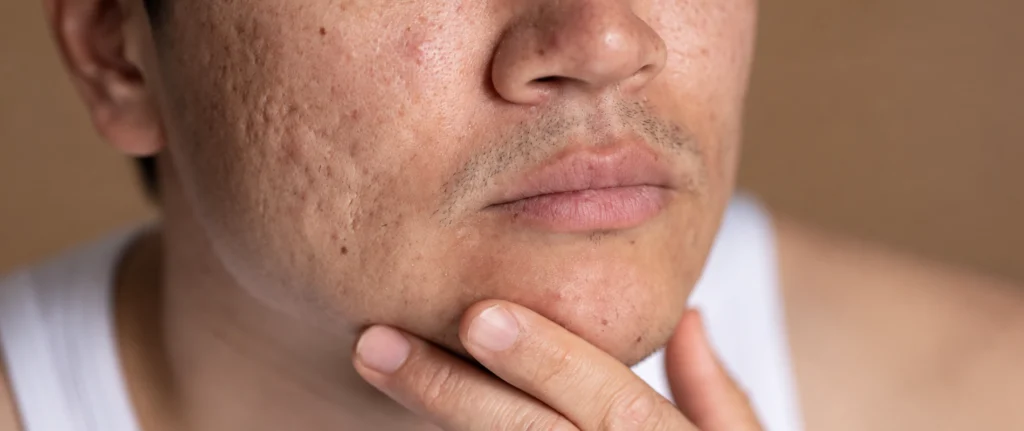
Acne scars are permanent or long-lasting structural changes that develop when acne inflammation damages the dermis and disrupts normal collagen repair. When the skin produces too little collagen during healing, it can leave atrophic or depressed scars; when it produces excessive collagen, raised hypertrophic or keloid scars can form. Atrophic scars are usually divided into ice-pick, boxcar, and rolling patterns. Ice-pick scars are narrow and deep, boxcar scars are broader depressions with defined edges, and rolling scars create wider wave-like depressions that are often pulled downward by fibrous bands beneath the skin. Flat brown or red acne marks are different because they represent post-inflammatory pigment or vascular change rather than a loss or excess of scar tissue. This distinction determines whether treatment should target collagen, tethering, volume, pigmentation, blood vessels, or a combination of these features.
Who is more likely to develop acne scars?
People with deep, inflammatory, long-lasting, or repeatedly untreated acne have a greater risk of permanent scarring. Nodules and deep inflammatory lesions can damage more dermal tissue than mild comedonal acne, while picking or squeezing adds mechanical trauma that may worsen both scar formation and pigmentation. Genetics also influence how a person’s skin repairs injury and whether the healing response tends toward depressed scars, hypertrophic scars, or keloids. Delaying effective acne treatment allows more inflammatory episodes to occur and therefore creates more opportunities for permanent collagen damage. People with darker skin tones may also develop prominent post-inflammatory hyperpigmentation around scars, although darker skin does not automatically mean more severe atrophic scarring. Preventing severe inflammation remains one of the most effective strategies for reducing future acne and acne scarring.
What to Expect from Acne Scar Treatment
Acne scar treatment usually involves gradual improvement rather than a one-time procedure that erases every scar. A dermatologist may need to treat different scar mechanisms separately—for example, releasing tethered rolling scars with subcision, treating narrow ice-pick scars with CROSS or a punch technique, and then using resurfacing or microneedling to refine broader texture. Collagen remodeling develops over time, so final results may continue improving for several months after a treatment. Some procedures require a series of sessions, while others are used only for selected scars. Recovery ranges from mild redness and swelling to a longer healing period after deeper resurfacing or surgery. A useful treatment plan therefore balances scar improvement against downtime, pigment risk, cost, and the number of stages a patient is willing to complete.
Realistic goals: improvement, not perfection
The aim of acne scar treatment is to make scars shallower, smoother, less tethered, less raised, or less visually prominent. Deep holes in the face from acne and severe acne pits can improve, but treatment cannot reliably reproduce skin that has never been scarred. Some scars respond more readily than others: a shallow rolling scar may improve substantially after the right combination, while a deep ice-pick scar may remain visible even after several targeted treatments. Lighting also changes the appearance of depressed scars, so improvement should be assessed under consistent conditions rather than based on a single photograph. Claims promising a “best cure acne scars” or complete pimple marks removal should therefore be viewed cautiously. A realistic endpoint is significant visible improvement with an acceptable safety profile.
Downtime, cost, and commitment
Different treatments involve different trade-offs. Microneedling may cause a few days of redness but often needs repeated sessions, while stronger fractional resurfacing may provide more intensive remodeling per session at the cost of greater recovery and pigment risk. Fillers can provide relatively immediate contour improvement but may require future touch-ups depending on the material used. Subcision can cause bruising and swelling while the released tissue heals, and focal scar surgery creates a new controlled wound that later needs to mature. Cost depends on scar extent, treatment area, number of visits, technology used, and whether combination therapy is required. Patients should also consider follow-up care, sun avoidance, skincare adjustments, and the ability to tolerate several months of staged treatment rather than viewing cost only as the price of one session.
How Dermatologists Assess Acne Scars
A dermatologist assesses acne scars by studying morphology, depth, distribution, tethering, color, skin phototype, active acne, previous treatment response, and healing history. The goal is to understand what physically creates each visible defect. A narrow deep scar requires a different treatment from a broad depression pulled downward by fibrous tissue, even if both look like “pits” to the patient. Scar assessment also considers whether brown pigmentation or red post-acne marks are making structural scars look more prominent. Patients with a history of keloids, persistent PIH, or poor wound healing may need additional caution with procedures. A proper clinical assessment turns the treatment decision from “Which machine is strongest?” into “Which mechanism needs to be corrected?”
Clinical evaluation and scar mapping
Scar mapping separates the face into different scar types and depths rather than assigning one diagnosis to the entire area. Side lighting, palpation, and stretching the skin can help reveal rolling scars and whether they are tethered to deeper structures. Ice-pick scars appear as narrow deep openings, while boxcar scars form broader round or oval depressions with more defined borders. Dermatologists also identify scars that may be better treated surgically through punch excision, punch elevation, or subcision rather than repeated resurfacing. Raised scars are mapped separately because increasing collagen would be inappropriate when the scar already contains excessive fibrous tissue. This morphology-first approach is one of the main reasons individualized acne scar treatment usually outperforms a standard treatment package.
Skin phototype and pigmentation risk
Skin tone affects procedure selection because every treatment that creates controlled inflammation has the potential to alter pigmentation. Darker and melanin-rich skin can still undergo microneedling, RF microneedling, lasers, peels, and other procedures, but device settings, density, treatment depth, pretreatment, and aftercare may need to be more conservative. RF microneedling and conventional microneedling are often useful in darker skin because they can stimulate dermal remodeling with relatively limited disruption of the epidermis compared with aggressive ablative resurfacing. Fractional CO₂ or erbium lasers may also be appropriate in selected darker skin types, but PIH remains a meaningful risk. A history of dark marks after acne or previous procedures can help predict pigmentation tendency. Skin tone should therefore modify treatment planning rather than being treated as an automatic exclusion.
Active acne status and skin barrier health
Significant active inflammatory acne is usually controlled before intensive scar revision begins because each new inflammatory lesion can create another scar. Treating scar tissue while deep acne continues to form also adds unnecessary inflammation to skin that is already healing. Dermatologists assess dryness, dermatitis, peeling, sensitivity, recent tanning or sun exposure, and the patient’s current skincare because a damaged barrier can make procedures harder to tolerate. Current medications, previous isotretinoin use, and wound-healing history also need review. The timing of procedures after isotretinoin is no longer based on one universal waiting period for every intervention; the specific procedure and patient factors matter. Preparing the skin properly can improve recovery and reduce complications.
Patient goals, downtime tolerance, and budget
Treatment planning should match what the patient wants to change most. Someone bothered primarily by three deep ice-pick scars may need a different plan from someone with broad rolling scars and generalized uneven texture. Some patients prioritize maximum improvement and can accept several days of recovery, while others prefer lower-downtime treatments even if progress is slower. Budget can influence whether treatment is staged across several procedures or concentrated on the most visually important scars first. Previous disappointing treatments should also be discussed because they can reveal whether the problem was incorrect scar selection, insufficient intensity, unrealistic expectations, or poor treatment response. A personalized treatment plan combines these preferences with what is medically suitable.
Treatment Options for Atrophic (Indented) Acne Scars
Atrophic acne scars develop when healing leaves insufficient collagen or fibrous tissue pulls the skin downward. The main types are ice-pick, boxcar, and rolling scars, but many patients have a mixture of all three. Treatment is most effective when it addresses the structural problem responsible for the depression rather than relying on one procedure for every scar. Tethered scars may need subcision, deep focal scars may require CROSS or punch surgery, and broader texture may respond to microneedling, RF microneedling, or fractional resurfacing. Fillers can restore volume under selected depressions. The relationship is therefore scar morphology → structural problem → targeted procedure → remodeling or elevation → gradual improvement.
Microneedling (collagen induction therapy)
Microneedling creates controlled microchannels in the skin, triggering a wound-healing response that promotes new collagen and scar remodeling. It can improve selected rolling scars, shallow boxcar scars, and broader uneven texture over a series of treatments. Because the treatment does not depend on selectively targeting melanin with light, it can be used across a broad range of skin tones and generally has a relatively low risk of pigment alteration when performed correctly. Improvement is gradual rather than immediate because collagen develops and reorganizes over time. Microneedling alone is less suitable for very deep ice-pick scars or scars that remain strongly tethered to deeper tissue. In those cases, CROSS, subcision, punch techniques, or combination therapy may provide a better structural match.
Microneedling radiofrequency (RF microneedling)
RF microneedling combines needle penetration with radiofrequency energy delivered into selected dermal depths. The needles create mechanical micro-injury while the thermal energy generates controlled coagulation, stimulating collagen remodeling around depressed scars. Adjustable depth and energy allow the dermatologist to modify treatment according to scar depth, facial region, skin tone, and desired intensity. RF microneedling can be useful for rolling and some boxcar scars and can improve broader skin texture without the same level of surface ablation produced by fractional CO₂ resurfacing. It has been used successfully in darker skin tones, although transient PIH and other complications remain possible. Stronger or deeper settings are not automatically better because excessive thermal injury can cause track marks, burns, prolonged inflammation, or additional scarring.
Fractional laser resurfacing (CO2 and erbium)
Fractional resurfacing creates microscopic columns of controlled injury surrounded by untreated skin that supports healing. Fractional CO₂ lasers are ablative and can improve selected rolling and boxcar scars by resurfacing scar edges and stimulating collagen remodeling beneath the surface. Erbium laser systems can also improve atrophic scars and may differ in thermal injury and recovery depending on wavelength, device design, and treatment settings. Ablative treatments generally involve more redness, crusting, recovery, and PIH risk than less aggressive non-ablative approaches. Darker skin tones can sometimes be treated safely, but conservative parameters and experience with pigment-prone skin are particularly important. Laser resurfacing can improve broad scar texture but should not be expected to release every tethered scar or eliminate a deep ice-pick tract by itself.
Dermal fillers for volume loss
Dermal fillers lift selected depressed scars by adding support beneath areas of volume loss. They are most useful for certain rolling and boxcar scars rather than narrow ice-pick scars. Fillers may be used after subcision when fibrous bands have been released but a residual depression remains. Depending on the filler, results may be temporary and require maintenance, while some materials are longer-lasting. The treatment can produce faster visible contour change than collagen-remodeling procedures because the depression is physically supported immediately. However, fillers do not correct every form of scar architecture and should be injected by a clinician familiar with acne scar anatomy and the vascular structures of the face.
Chemical reconstruction of skin scars (CROSS) for ice-pick scars
CROSS is a focal technique in which a high-strength chemical, most commonly trichloroacetic acid, is applied precisely inside selected atrophic scars. It is especially relevant for narrow ice-pick scars and some small deep boxcar scars because it treats individual depressions rather than peeling the entire facial surface. The controlled chemical injury stimulates remodeling within the scar over subsequent weeks and months. Several treatments may be needed, and improvement rather than complete disappearance is the realistic goal. Risks include prolonged redness, post-inflammatory hyperpigmentation, hypopigmentation, and enlargement or merging of adjacent scars if acid spreads outside the intended area. For this reason, TCA CROSS should not be attempted as a home remedy for deep acne scars.
Chemical peels for superficial texture and pigmentation
Chemical peels vary from superficial to deeper treatments and therefore have different roles in acne scar management. Superficial peels can help active acne, rough surface texture, and post-inflammatory pigmentation but have limited ability to correct deep structural scars. Medium or stronger peels may create more remodeling but also carry greater recovery time and pigment risk, particularly in darker skin. Peels can be useful as one part of a combination plan rather than a universal treatment for ice-pick, boxcar, and rolling scars. TCA CROSS should also not be confused with a full-face chemical peel because CROSS selectively treats individual scars. In pigment-prone patients, careful selection of peel depth and appropriate photoprotection are particularly important.
Treating Post-Acne Discoloration Alongside Scars
Acne scars and post-acne discoloration often occur together, but they are separate problems. A patient may have depressed scars plus brown PIH, red PIE, or both, and treating only the texture can leave the overall appearance uneven. Conversely, brightening a dark area does not restore missing collagen beneath an atrophic scar. Pigment, vascular redness, scar depth, and tethering therefore need to be assessed independently. This distinction is particularly relevant in darker skin, where discoloration can be more noticeable than the physical depression itself. A staged treatment plan may improve color first or alongside structural scar revision depending on the patient’s priorities and pigment risk.
Post-inflammatory hyperpigmentation (dark marks)
Post-inflammatory hyperpigmentation is a flat brown, dark brown, grey-brown, or blue-grey mark caused by excess melanin after acne inflammation. PIH is not itself an acne scar, even though patients frequently search for pimple marks treatment, spot scar treatment, or acne scar removal when describing these marks. Active acne control, broad-spectrum sunscreen, azelaic acid, topical retinoids, and selected pigment-directed therapies can help. Chemical peels or carefully selected laser treatments may be considered when pigmentation remains persistent. In darker skin, excessive treatment intensity can cause additional PIH, so pigment management should be conservative and deliberate. When PIH overlies a structural scar, both problems may need different treatments.
Post-inflammatory erythema (red marks)
Post-inflammatory erythema consists of flat red, pink, or purple-red marks caused primarily by persistent vascular changes after inflammation. PIE is not a structural scar and should not automatically be treated with pigment-lightening products. Redness may gradually fade without intervention, but persistent cases can sometimes be treated with vascular-targeted laser or light therapy when appropriate for the patient’s skin type. A red mark over a depressed scar can make the depression appear more obvious, so improving the vascular component may enhance the overall result even without changing scar depth. Irritating skincare can prolong redness and should be minimized. The treatment target here is vascular change rather than excess melanin.
At-Home and Topical Treatments That Help Fade Scars
Topical skincare has an important supportive role, but its limitations should be clear. Retinoids, salicylic acid, azelaic acid, alpha-hydroxy acids, vitamin C, and similar ingredients may improve active acne, pigmentation, and mild surface irregularity. They cannot reliably release fibrous bands, replace substantial lost volume, close a deep ice-pick scar, or flatten a keloid. This is why many products advertised for pimple marks removal perform better on flat discoloration than on true pitted acne scars. Home care is most valuable for preventing new acne, improving skin tone, maintaining barrier health, and supporting recovery around professional procedures. Structural scar revision generally requires treatment that reaches or alters the deeper dermis.
Sun protection as a non-negotiable foundation
Daily broad-spectrum sunscreen helps prevent post-inflammatory pigmentation from becoming darker and reduces additional UV-related changes in healing skin. It is particularly important before and after lasers, peels, microneedling, subcision, and other procedures. SPF 30 or higher is a practical baseline, with reapplication and additional shade or protective clothing when exposure is substantial. Tinted sunscreens containing iron oxides can provide extra visible-light protection for people who develop persistent hyperpigmentation. This is particularly relevant in high-UV environments such as Riyadh. Sunscreen does not rebuild scar tissue, but reducing color contrast can make acne scars appear less prominent and supports safer procedural recovery.
Proven ingredients to help fade acne scars and marks
Topical retinoids can prevent new acne and may gradually improve superficial texture and post-acne pigmentation through normalization of epidermal turnover. Salicylic acid helps control clogged pores and can improve surface roughness, while azelaic acid is useful when active acne and PIH occur together. Alpha-hydroxy acids may provide controlled exfoliation for superficial unevenness, and vitamin C or niacinamide can support improvement in uneven pigmentation. These ingredients are better described as treatments for acne, surface texture, and marks than as a cure for deep structural acne scars. A patient with acne pits on the face should not expect skincare to produce the same structural change as subcision, punch treatment, filler, or resurfacing. Introducing multiple actives too quickly may also cause irritation and worsen pigmentation.
What not to do
Do not use strong acids, needles, or abrasive devices at home in an attempt to remove acne scars more quickly. Home TCA CROSS and aggressive dermarolling can cause burns, infection, permanent pigment change, or additional scarring because treatment depth is difficult to control safely. Lemon juice, toothpaste, undiluted essential oils, apple cider vinegar, honey, and similar home remedies have no reliable ability to replace lost dermal collagen or release tethered scars. Natural oils may moisturize the skin but should not be presented as a proven cure for pitted acne scars. Avoid picking and repeatedly manipulating scars or active pimples. If the treatment itself is causing significant inflammation, it may worsen the very pigmentation and scarring the patient is trying to correct.
Combining Treatments for Enhanced Results
Combination therapy is often useful because most patients do not have only one scar type. A face can contain rolling scars attached by fibrous bands, deep ice-pick scars, shallow boxcar scars, PIH, and red post-acne marks at the same time. No single treatment addresses all of these problems equally well. Dermatologists therefore often combine procedures that release scars, replace lost volume, stimulate collagen, resurface edges, and treat discoloration. The treatments may be performed in stages rather than all in one visit so that inflammation remains controlled and results can be reassessed. Combining treatments should be based on complementary mechanisms rather than simply adding more procedures.
Why combination therapies deliver the best results
Each acne scar treatment has a specific biological target. Subcision cuts fibrous bands under tethered rolling scars, fillers add support to selected depressions, CROSS remodels narrow deep pits, and fractional resurfacing improves scar edges and broader texture. Microneedling and RF microneedling stimulate collagen across larger areas but cannot mechanically release every anchored scar. Punch excision or punch elevation can be considered for selected deep, sharply defined scars that respond poorly to surface resurfacing. Because mixed scars involve several mechanisms, matching multiple tools to the individual components can produce a more balanced improvement than repeatedly performing one procedure. The phrase “best acne scar treatment” is therefore most useful when interpreted as the best treatment for a particular scar, not the best device overall.
Common combinations
Tethered rolling scars may be released with subcision before microneedling, RF microneedling, fractional laser resurfacing, or filler is used to refine residual depressions. Deep ice-pick scars may undergo TCA CROSS or selected punch excision before resurfacing is used for the surrounding skin. Shallow boxcar scars may respond to fractional laser or microneedling, while deeper boxcar scars may require focal elevation, filler, or surgical correction. PRP may be used as an adjunct to microneedling or laser treatment, although evidence is variable and it should not be presented as essential or guaranteed to improve every outcome. Pigmentation may be treated with topical therapy and sun protection between procedures rather than increasing laser intensity. In selected cases, dermabrasion can provide deeper resurfacing, whereas microdermabrasion mainly improves surface tone and is not a primary treatment for structural acne scars.
Benefits of a combined, staged approach
A staged plan allows the dermatologist to correct the deepest structural problems first and then refine the remaining texture. Releasing tethered scars before resurfacing, for example, allows the skin to rise before additional collagen remodeling is attempted. Treating pigmentation between procedures can also reduce visible unevenness and help pigment-prone skin recover before the next treatment. Staging allows the clinician to reassess which scars still need treatment instead of committing to a fixed package in advance. It can also reduce the amount of unnecessary injury applied to areas that have already responded. The main advantage is therefore precision—not simply performing more treatments.
Prevention Still Matters
Preventing additional scars is an essential part of every scar treatment plan because new inflammatory acne can continue damaging collagen while old scars are being revised. Effective acne management, gentle skincare, and avoiding manipulation of lesions reduce this risk. Prevention is particularly important for patients prone to keloids or persistent PIH because new lesions can create several long-term problems at once. Treating acne early is usually easier than treating established structural scarring later. Scar procedures should therefore complement, not replace, a long-term acne-control plan.
Treat active acne early to prevent new scars
Active inflammatory acne should be treated according to severity and individual needs. Options may include topical retinoids, benzoyl peroxide, azelaic acid, oral antibiotics for selected inflammatory cases, hormonal treatment in appropriate women, or isotretinoin for severe or scarring acne. The purpose is not only to clear existing lesions but also to prevent repeated dermal injury. A patient who continues to develop nodules or deep inflammatory acne while undergoing scar procedures may continue producing new scars. This is why acne control generally comes before intensive scar revision. Maintenance treatment may also be required after active acne improves.
Avoid picking and squeezing lesions
Picking, squeezing, and repeatedly touching inflammatory lesions can increase tissue trauma and prolong inflammation. This raises the chance of dark marks and can contribute to deeper structural damage. Large nodules should not be forcibly drained at home because pressure can injure surrounding tissue without adequately treating the underlying inflammation. Dermatologists can sometimes treat selected painful lesions medically when rapid reduction is necessary. Avoiding manipulation is especially important for patients who form hypertrophic scars or keloids easily. Preventing an avoidable scar is always simpler than revising it later.
Use gentle, barrier-friendly skincare and daily sunscreen
Acne treatment and scar procedures work better when the skin barrier is healthy enough to tolerate them. Use a gentle cleanser, non-comedogenic moisturizer, and appropriate acne medication rather than repeatedly stripping or scrubbing the skin. Daily sunscreen reduces post-inflammatory pigmentation and is particularly important around resurfacing procedures. Avoid layering several exfoliating acids onto skin that is already peeling or inflamed from retinoids or procedures. Barrier-friendly skincare does not directly lift a deep scar, but it reduces avoidable inflammation and helps treatment proceed more safely. This is especially valuable for patients with sensitive or pigmentation-prone skin.
When to See a Dermatologist for Acne Scars
A dermatology assessment is appropriate when scars are deep, numerous, worsening, raised, causing persistent pigmentation, or affecting confidence or quality of life. Professional evaluation is also useful when it is difficult to determine whether a mark is PIH, PIE, an atrophic scar, or a keloid. Raised scars need a different treatment pathway from depressed scars and may require corticosteroid or other injections, silicone therapy, vascular laser treatment, cryotherapy, or carefully selected surgery because keloids can recur. Atrophic scars may require subcision, punch surgery, fillers, CROSS, microneedling, RF microneedling, or resurfacing depending on their morphology. Patients considering an acne scar dermatologist in Riyadh should look for individualized assessment of scar type, skin tone, pigment risk, and active acne rather than a clinic that recommends one laser for every patient. A useful consultation should also cover expected improvement, possible side effects, recovery, number of stages, and cost.
Frequently Asked Questions About Acne Scar Treatment
There is no single most effective treatment for all acne scars. Rolling scars often benefit from subcision and collagen-remodeling procedures, ice-pick scars may respond to CROSS or punch techniques, and boxcar scars may require resurfacing, microneedling, RF microneedling, fillers, focal surgery, or combinations depending on depth.
Complete removal cannot be guaranteed. Modern treatments can make many scars substantially less noticeable, but some residual depression, texture, or color difference often remains, particularly with deep or severe acne scars.
TCA CROSS and selected punch techniques are commonly used for deep ice-pick scars because they treat narrow focal defects directly. Fractional resurfacing or other procedures may later be added to improve surrounding texture.
Yes. Microneedling stimulates collagen remodeling and can improve selected rolling and shallow boxcar scars. Very deep ice-pick scars and strongly tethered rolling scars often require additional focal or releasing treatments.
Fractional laser can be appropriate for selected darker skin tones, but post-inflammatory hyperpigmentation is a meaningful risk. Laser type, treatment density, energy, recent sun exposure, pigmentation history, and clinician experience should all influence treatment settings.
Yes. Poorly selected or overly aggressive treatment can cause prolonged redness, infection, PIH, hypopigmentation, burns, or additional scarring. TCA CROSS, subcision, lasers, peels, and needling all require correct technique and appropriate aftercare.
Generally, yes. Controlling significant inflammatory acne helps prevent new scars from forming while existing scars are being treated and reduces unnecessary inflammation during scar procedures.
The timeline depends on the procedure and scar severity. Fillers can produce relatively immediate contour change, while microneedling, RF microneedling, CROSS, and laser resurfacing rely partly on collagen remodeling that continues for weeks to months. Multiple sessions or staged treatments are common.
Conclusion
Effective acne scar treatment begins with identifying the type, depth, and underlying mechanism of each scar. Ice-pick, boxcar, rolling, hypertrophic, and keloid scars should not be grouped into one treatment category, and flat PIH or PIE should not be mistaken for structural scars. Atrophic scars may be treated with subcision, microneedling, RF microneedling, fractional CO₂ or erbium resurfacing, fillers, TCA CROSS, chemical peels, dermabrasion, or selected punch techniques. Raised scars need a different strategy designed to reduce excess scar tissue rather than stimulate more collagen. Topical skincare can improve acne, pigmentation, and superficial texture but cannot reliably reconstruct deep acne pits. For mixed scarring, a personalized staged approach that addresses tethering, scar depth, volume loss, texture, pigmentation, and skin tone separately often provides the most logical route to meaningful improvement.